If your child has developed pain at the front of the knee that appears during basketball and settles with rest, you are dealing with one of the most common complaints in youth sport. It is also one of the most commonly mismanaged, because the standard advice of resting until it stops hurting frequently does not resolve it and sometimes makes the return worse.
Knee pain in young basketball players is usually related to growth rather than to injury in the way most parents assume. Understanding that changes how you manage it.
Why Basketball Produces So Much of This
Basketball is a jumping and cutting sport. Every rebound, every layup, every change of direction loads the knee repeatedly. Across a season that is thousands of repetitions.
Layer a growth spurt on top of that and the picture changes further. During rapid growth, bones lengthen faster than the muscles and tendons attached to them can adapt. Everything becomes tighter and the points where tendons attach to bone take considerably more load than usual.
In a growing basketball player, the tendon below the kneecap is pulling repeatedly on a growth area at the top of the shin, at exactly the moment that area is most vulnerable. That is why knee pain clusters so predictably around the growth years.
The condition most commonly responsible has a name, Osgood-Schlatter, and the Jr. NBA health guidance describes it as pain, swelling and soreness at the bony bump just below the knee, occurring during the adolescent growth spurt in young athletes doing a lot of running and jumping.
What It Typically Looks Like
A tender bump below the kneecap. Often visible as well as tender. Frequently more prominent on one side than the other.
Pain that appears with activity and settles with rest. Worse during and immediately after basketball, better the following morning.
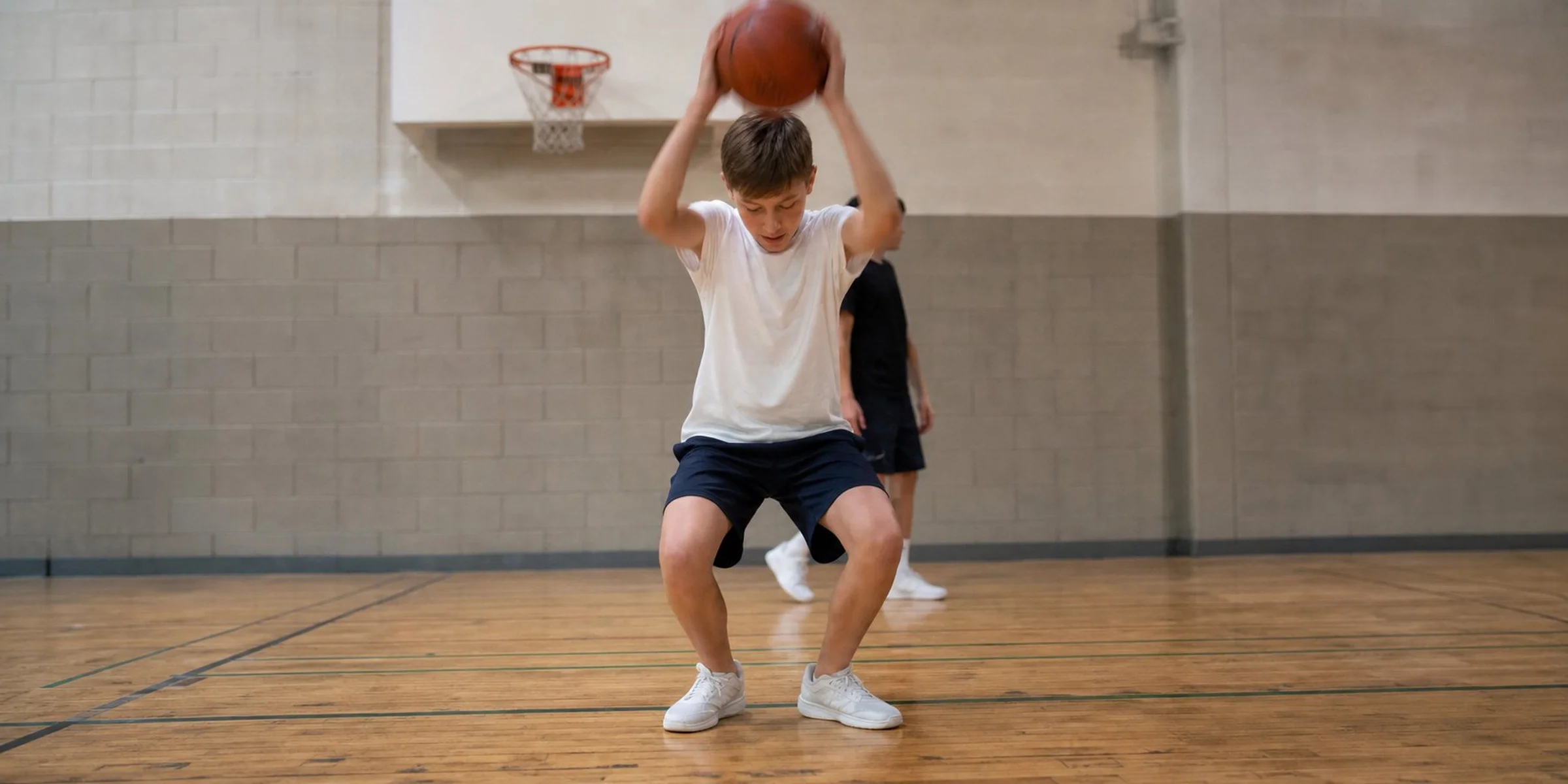
Worse with jumping, sprinting, squatting and stairs. These are the movements that load the patellar tendon hardest.
Gradual onset with no specific injury. Nobody can point to a moment it happened. It built up over weeks.
Common ages. It typically appears around ten to twelve in girls and twelve to fourteen in boys, during or just after a rapid growth phase.
It can affect one knee or both. One side is more common but bilateral cases are frequent.
Importantly, none of this is a diagnosis. A tender bump below the knee in a growing basketball player is a strong pattern, but knee pain in young athletes has several possible causes and some need excluding properly. That is a job for a doctor or physiotherapist, not for a coach or a website.
Why Rest Alone Frequently Fails
This is the part most families are not told, and it is why the problem so often drags on for a year or more.
Complete rest does settle the symptoms. Remove the load and the irritation calms down. The problem is that nothing else has changed. The player has not become stronger, the tendon has not built capacity, and the growth spurt is still happening.
So the player returns after three weeks off, resumes the same training volume, and the pain returns within a fortnight. That cycle repeats through a whole season, and each time it does the player loses fitness, loses skill development and loses confidence.
What tends to work better is not rest but load management. Reducing the volume of jumping and sprinting to a level the knee tolerates, while keeping the player active and building strength around the joint. This keeps them playing, keeps them developing, and gives the tissue a chance to adapt rather than simply being switched off and on.
That is a conversation to have with a physiotherapist who can assess the specific player. But the principle is worth understanding, because it is very different from the rest until it stops hurting advice most families receive.
What Parents Can Actually Do
Take it seriously early. Pain that has been present for two weeks and is not improving warrants a proper assessment rather than being dismissed as growing pains. Early management shortens the whole episode considerably.
Track your child’s height. This sounds odd and it is genuinely useful. A standing height check once a month tells you when your child is in a rapid growth phase, which is exactly the window when load needs watching most carefully. Two thirteen-year-olds can be in completely different stages of growth.
Watch for the load spike. These problems very often appear after a jump in training volume. The start of a season, a tournament weekend, joining a second team, or moving from one practice a week to three. Growth spurts are not a reason to stop training, but they are a poor time to increase it sharply.
Do not let them push through significant pain. Mild discomfort that settles quickly is different from pain that worsens through a session or persists the next day. The second one means the load was too high.
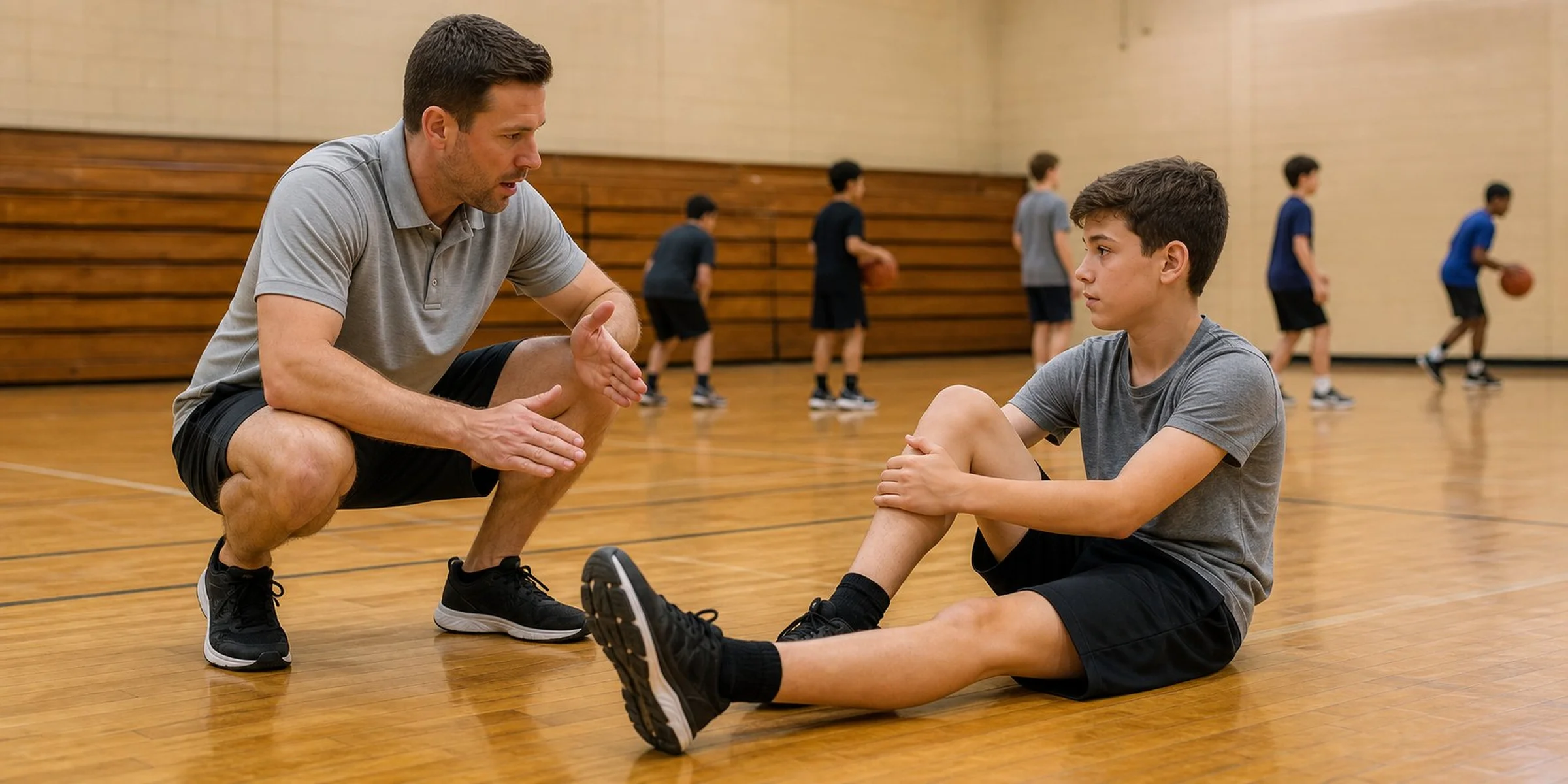
Tell the coach. A coach who knows can modify the session. A coach who does not know cannot. This is one of the most useful things a parent can do and it is frequently not done.
Our guide on youth basketball conditioning drills covers building general fitness in ways that do not rely purely on high-impact jumping volume.
How Good Coaching Reduces the Risk
This is where a training programme either helps or contributes to the problem.
Monitoring total load, not just session load. A player might have one practice with us, two with their school team, a tournament at the weekend and shooting in the driveway every evening. No individual session is excessive. The total is. Coaches who ask what else a player is doing can manage this. Coaches who only count their own sessions cannot.
Building strength alongside skill. Stronger quadriceps, hamstrings and glutes distribute load more effectively and reduce the strain on tendon attachment points. Youth strength training, done appropriately for age and supervised properly, is well supported in the sports science literature and is not the risk many parents assume it to be.
Coaching landing mechanics. How a player lands from a jump determines how much load goes through the knee. Landing softly with knees tracking over the toes rather than collapsing inward is coachable, and it matters for both current symptoms and long-term injury risk. Our guide on jumping higher for basketball covers the mechanics.
Progressing volume gradually. Sharp increases in jumping and sprinting volume are the most common trigger. Sensible progression is unglamorous and effective.
Adjusting for individual players. A player going through a growth spurt may need a modified session while teammates do the full one. That requires a coach paying attention to individuals rather than running everyone through the same programme.
At YouHoop we manage session load deliberately and we ask families about what else a player is doing, because the total picture is what matters. You can read more about our approach on our about page.
When to See a Professional
Some presentations need proper assessment rather than a period of watchful waiting.
Pain that has persisted more than two weeks without improving. Pain present at rest or waking the player at night. Significant swelling around the joint. The knee locking, catching or giving way. Pain following a specific injury or fall rather than building gradually. Any pain the player is limping on.
None of these mean something serious is necessarily wrong. They mean a proper look is warranted rather than guessing.
A physiotherapist or doctor can confirm what is actually going on, rule out the alternatives, and build a specific loading programme. That is considerably more useful than a generic recommendation to rest.
The Longer View
Two things are worth holding on to as a parent.
This is usually self-limiting. Growth-related knee pain typically resolves as growth plates mature. It can take months and it can be genuinely frustrating along the way, but the large majority of players come through it and return to full activity.
Handled well, they do not have to stop playing. The goal is not to remove basketball. It is to manage the load so the player keeps developing while the tissue catches up. Players who disappear from the sport for six months lose fitness, skill and often their connection to the team. Managed properly, most can keep participating in a modified form throughout.
Research on youth athletic development also consistently supports multi-sport participation and adequate rest in the early teenage years, which our guide on what age to start AAU basketball covers in the context of specialisation. Broader youth development guidance is published by USA Basketball.
If your player is managing knee pain and you want a training environment that will actually adjust for it rather than running them through the same session as everyone else, book a welcome call with our team and we will talk through how we would handle it.

0 Comments