Most young players who want to know how to jump higher for basketball go looking for a jump programme when what they actually need is a strength programme. Vertical jump is not a separate skill you train in isolation. It is the visible output of force production, and force production comes from strength applied quickly.
This guide covers what genuinely increases vertical jump in young athletes, what the sequence should be, and the common approaches that produce very little despite feeling productive.
What Actually Determines Vertical Jump
Three things, in roughly this order of importance for a young athlete.
Maximum strength. How much force your legs can produce. A player who cannot squat their own bodyweight has a low ceiling on their jump regardless of how much plyometric work they do, because there is not enough force available to convert into speed.
Rate of force development. How quickly you can produce that force. A jump happens in around a quarter of a second, so being strong slowly is of limited use. This is what plyometric training develops, and it only works once there is strength to accelerate.
Technique and coordination. How efficiently you use the force you have. Arm swing, depth of countermovement, timing of the sequence from hips to knees to ankles. Technique alone can add a meaningful amount to a jump without any change in strength.
There is also a fourth factor most young players ignore entirely, which is bodyweight relative to strength. Jump height depends on force relative to mass, which is why improving body composition alone can raise vertical jump.
The Sequence That Works
Phase one: build base strength. For most young athletes this is the missing piece and it is where the largest gains sit. Squats, deadlifts, split squats and hip hinge patterns, performed with good technique and progressive load.
This phase should run eight to twelve weeks for a player with little strength training history. Attempting to skip it and go straight to jump training is why so many players plateau quickly.
Phase two: add explosive work. Once a strength base exists, plyometric training converts that strength into speed. Box jumps, broad jumps, depth jumps, bounding. Low volume, full recovery between sets, quality over quantity.
Phase three: integrate and maintain. Combining continued strength work with explosive training and sport-specific jumping, maintaining gains through the season.
Our guide on basketball speed and agility training covers the broader athletic development picture this sits within.
The Strength Exercises That Matter Most
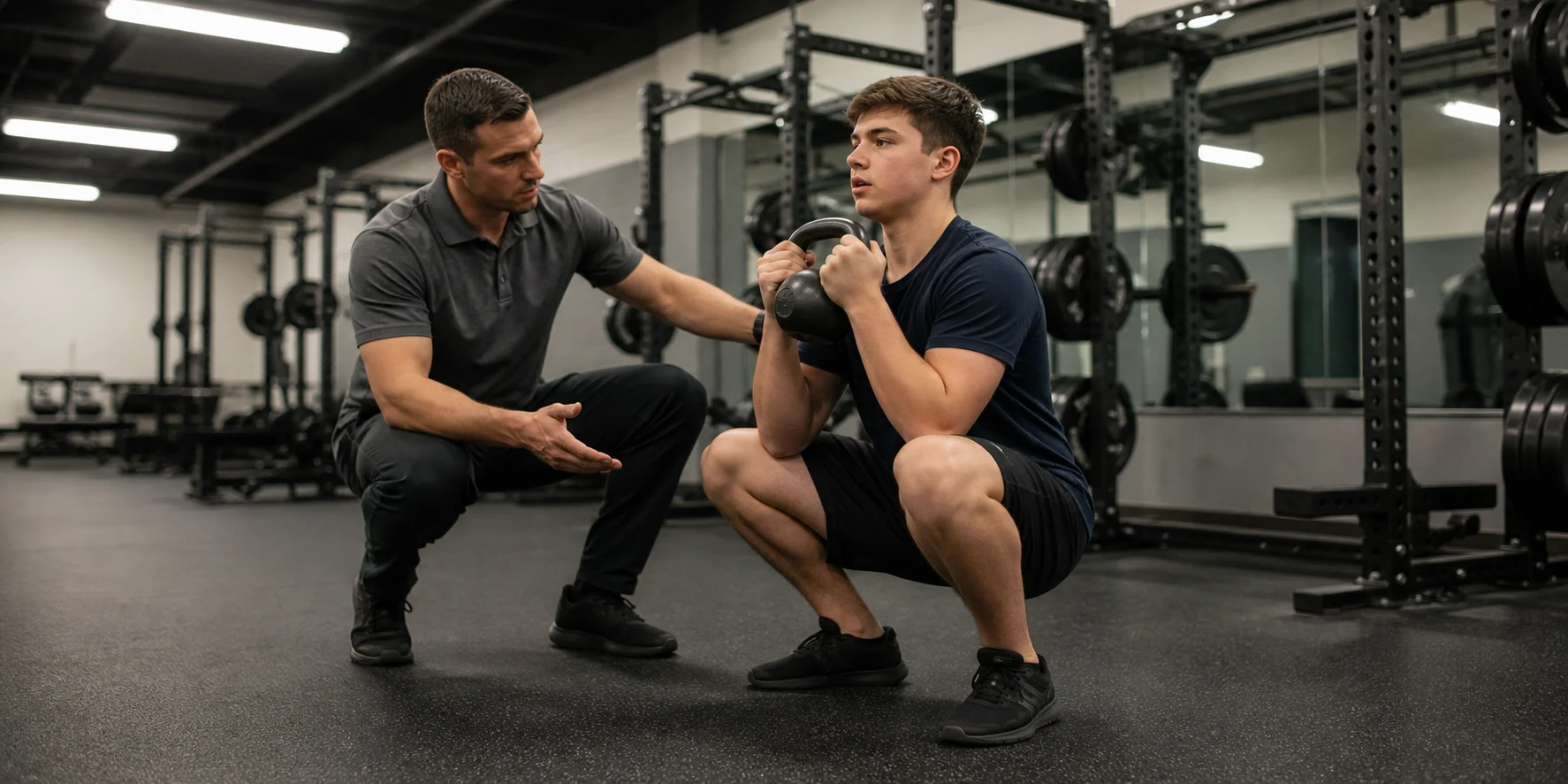
Squat variations. Goblet squats and front squats for younger athletes, progressing to back squats as technique allows. These develop the quadriceps and glutes that drive the upward phase of a jump.
Hip hinge patterns. Romanian deadlifts and trap bar deadlifts develop the posterior chain, particularly the glutes and hamstrings, which contribute substantially to explosive hip extension.
Split squats and lunges. Single leg strength matters because many basketball jumps happen off one foot, and because single leg work exposes and corrects left to right imbalances.
Calf and ankle work. The final part of the jump sequence comes through the ankle. Calf raises and ankle stiffness work are frequently neglected and contribute more than players expect.
Core stability. Not sit-ups. Anti-rotation and anti-extension work such as planks, dead bugs and Pallof presses, which allow force to transfer from legs to the rest of the body without energy leaking out through a soft midsection.
For young athletes still growing, technique quality matters considerably more than load. Heavy weight with poor mechanics builds injury risk rather than jump height.
The Plyometric Work That Converts Strength Into Jump
Plyometrics are the bridge between being strong and being explosive, but they are widely misused.
Box jumps. Focus on the takeoff, not the height of the box. Stepping down rather than jumping down protects the joints. A moderate box performed with maximum intent beats a high box scrambled onto with poor form.
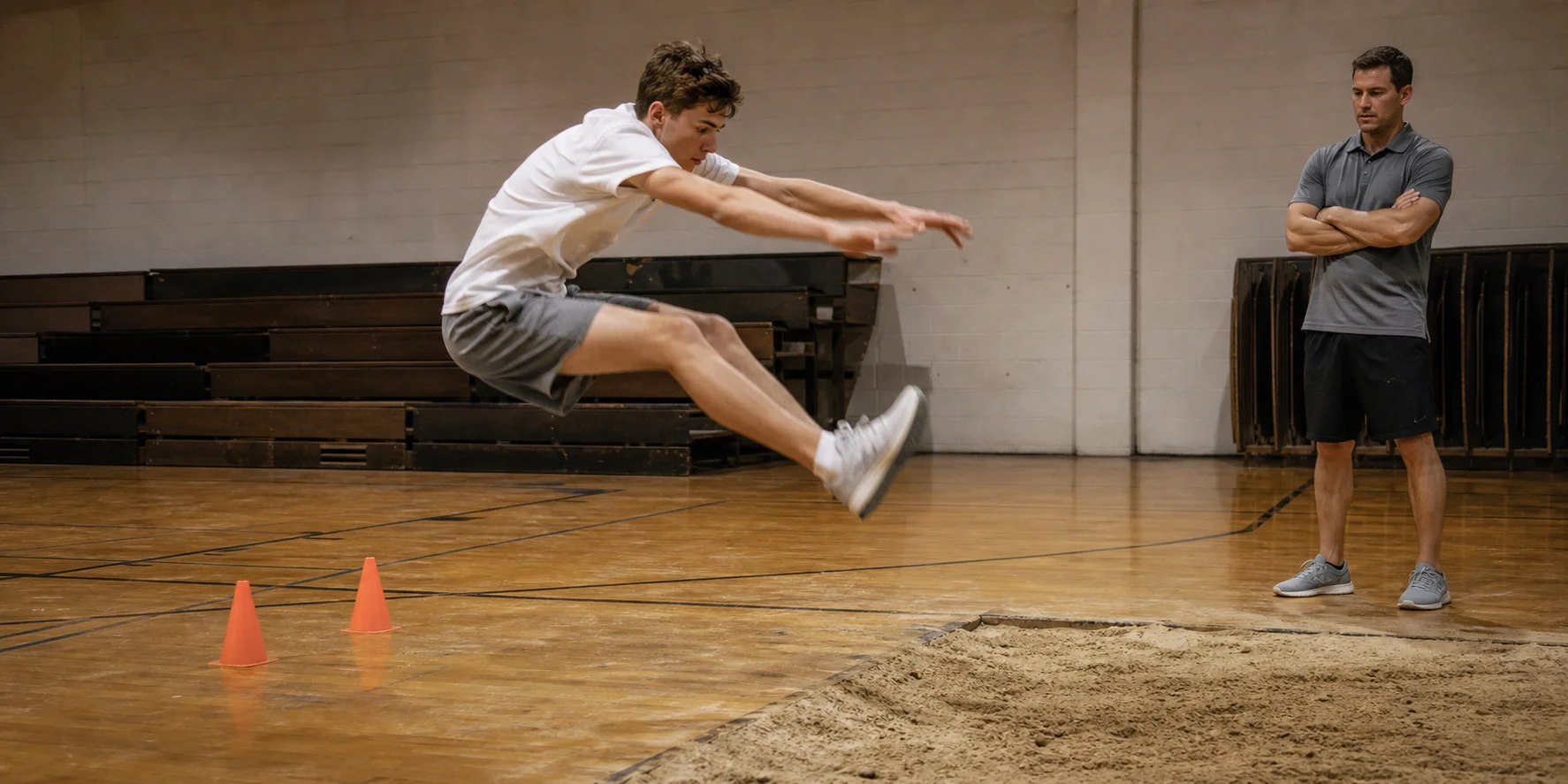
Broad jumps. Horizontal power development, which transfers well to basketball movement.
Depth jumps. Stepping off a low box and immediately jumping on landing. Highly effective but only appropriate once a genuine strength base exists, and only in low volumes.
Pogo hops. Small fast repeated hops focusing on minimal ground contact time. Develops ankle stiffness, which is where a meaningful proportion of jump efficiency comes from.
Approach jumps. Practising the actual basketball jump, both one foot and two foot, with maximum intent.
The critical principle in plyometric training is quality over volume. These should be performed fresh, with full recovery between sets, and stopped as soon as the quality drops. Doing a hundred fatigued jumps builds endurance rather than power.
Technique Gains That Cost Nothing
Before adding any training, several technique adjustments can add height immediately.
Use your arms properly. A full downward then upward arm swing, timed with the leg drive, contributes a meaningful proportion of jump height. Many young players keep their arms passive or mistime the swing entirely.
Find the right countermovement depth. Too shallow and you generate insufficient force. Too deep and you lose the elastic energy stored in the muscles and tendons. A moderate quick dip is usually optimal and worth experimenting with.
Minimise ground contact time on approach jumps. The longer your feet are on the floor, the more stored elastic energy dissipates. Quick and sharp beats slow and deep for approach jumps.
Full extension. Finishing the jump with hips, knees and ankles fully extended. Players who leave the ground in a partially bent position are wasting available range.
Practise the actual jump you use in games. A one-foot layup jump and a two-foot rebound jump are different skills. Train the one you use.
What Does Not Work
Jump programmes without strength work. For a young athlete with little strength base, high volume jumping produces early small gains and then a rapid plateau, plus a raised risk of overuse injury at the knee.
Ankle weights and weighted vests for jumping. They alter the movement pattern and increase joint stress without producing meaningful jump improvement in young athletes.
Jumping every day. Plyometric training is a high stress stimulus. Two to three quality sessions per week with recovery between them produces better results than daily jumping.
Excessive volume. A hundred jumps in a session trains endurance rather than power. Twenty to forty quality contacts with full intent is more productive.
Neglecting landing mechanics. Poor landing technique is the primary source of knee injury in jumping athletes. Landing softly with knees tracking over toes should be trained as deliberately as the jump itself.
Ignoring sleep and nutrition. Adaptation happens during recovery. A young athlete sleeping six hours a night will not respond well to any training programme. Our guide on basketball nutrition for youth athletes covers the fuelling side.
Considerations for Young Athletes
Growth matters. During rapid growth phases, coordination temporarily declines and the risk of tendon irritation at the knee rises. Training load should be moderated rather than pushed through during these periods.
Technique before load, always. A young athlete lifting with poor mechanics is building injury risk. Loading should progress only as technique holds.
Bodyweight strength first. Before adding external load, a young player should be able to control bodyweight squats, split squats and hinge patterns properly.
Supervision matters. Most technique faults in strength and plyometric training are invisible to the person performing them, which is why coached sessions produce considerably better results and lower injury rates than self-directed programmes.
Our skill training and athletic development sessions include supervised strength and explosive work appropriate to each athlete’s stage. To find the right pathway, book a welcome session with our team.
Realistic Expectations
Vertical jump improves more slowly than most young players hope and more reliably than they fear.
An athlete with no strength training background typically sees noticeable improvement within eight to twelve weeks of consistent strength work, before any dedicated jump training begins. Adding plyometric work after that base is built produces further gains over the following two to three months.
Beyond that, progress becomes slower and requires more structured programming. Substantial jump improvement is a multi-year process rather than a summer project, which is worth setting out honestly with young athletes who see rapid transformation promised online.
The players who improve most are consistently the ones who trained the boring strength work properly rather than those who did jump-specific drills exclusively.
For off-season programming context, see our guide on the off-season basketball training programme, and for conditioning see our youth basketball conditioning drills.
Youth athletic development guidance is published by USA Basketball and general youth strength training guidance is available through the National Strength and Conditioning Association.

0 Comments