The free throw is the only shot in basketball where nobody is guarding you, the distance never changes, and you have as long as you need to get ready. It is the most controllable shot in the game and consequently the most improvable.
It is also the most neglected. Players spend hours working on crossovers and step-backs and then miss the shot that decides close games. Learning how to improve free throw shooting is one of the highest-return investments a young player can make, because unlike most skills the gains are almost entirely within your control.
Why Free Throws Are Missed
Understanding the cause determines the fix.
Inconsistent setup. Feet in a slightly different position each time, ball held at a different height, different number of dribbles. Small variations in setup produce large variations in outcome because everything downstream is built on it.
Rushing. Young players frequently shoot within two seconds of receiving the ball. Rushing prevents the routine from doing its job of settling the body and the mind.
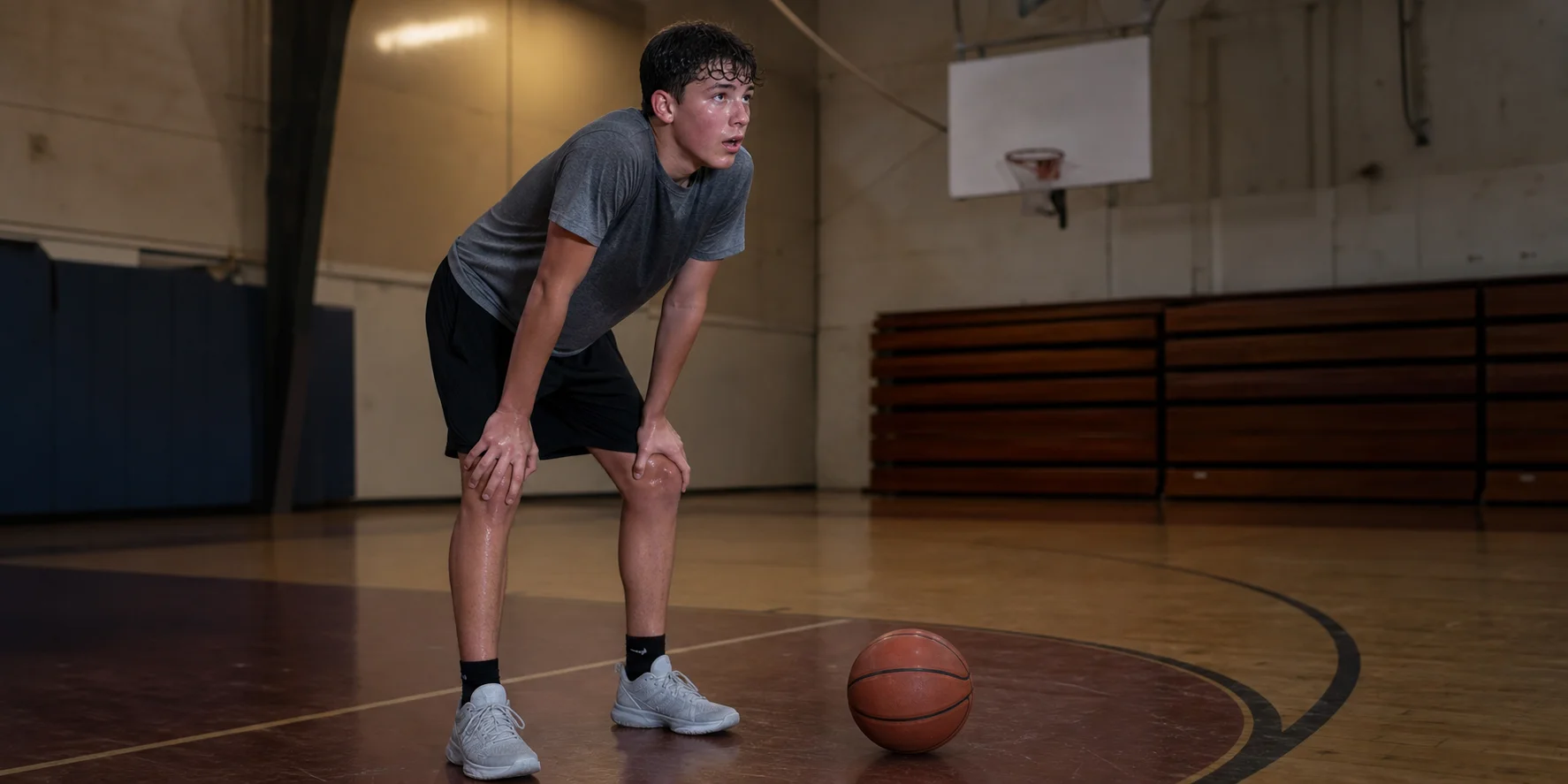
Fatigue. Free throws usually happen after a hard effort, when legs are tired and breathing is heavy. Practising them fresh and shooting them tired is a mismatch most players never address.
Pressure. The free throw is the only moment in basketball where everyone stops and watches one player. For a young athlete that attention is significant and the response is usually to rush.
Poor mechanics under fatigue. Technique that holds up when fresh frequently breaks down when tired, most commonly through the elbow drifting outward and the legs contributing less.
The Mechanics That Matter
Feet and alignment. Set the shooting-side foot so the toe points at the centre of the rim, with the other foot slightly behind and shoulder width apart. Most gyms have a small marking at the centre of the free throw line which gives a consistent reference point. Using the same reference every single time is the foundation of consistency.
Knee bend. The power comes from the legs, not the arms. A consistent, moderate knee bend, the same depth every time, produces a consistent shot. Players who bend deeply when fresh and barely at all when tired will miss short late in games.
Ball position. The ball should start in the same place every time, typically around waist or chest height, and travel a consistent path to the release point.
Elbow under the ball. The shooting elbow should sit roughly under the ball rather than flaring out to the side. Flaring elbow is the single most common mechanical fault and it sends shots sideways.
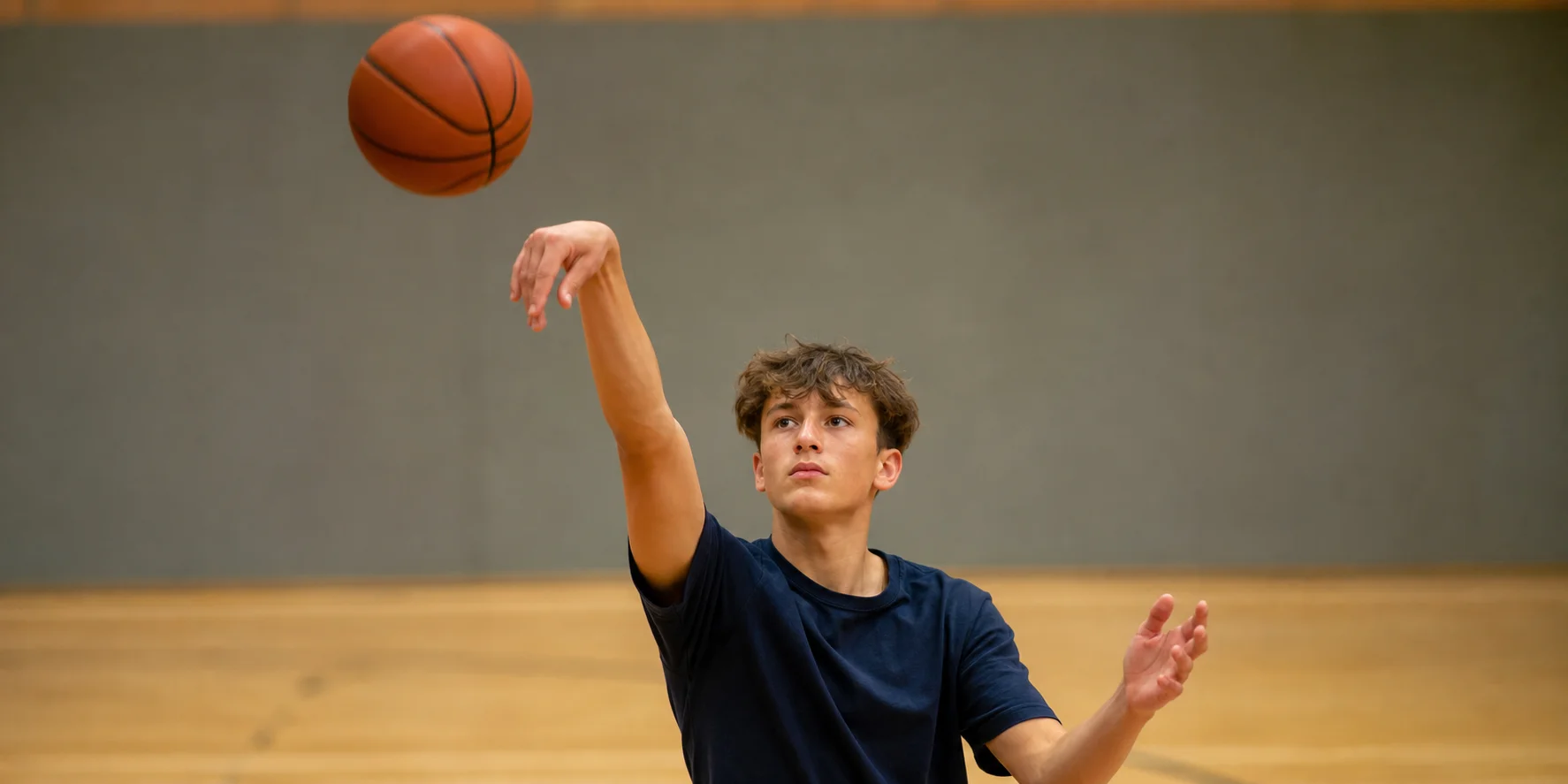
Release and follow through. The wrist snaps down and the fingers finish pointing at the rim. The follow through should be held until the ball reaches the basket. Players who drop their hand immediately are usually cutting the shot short.
Eyes on a single target. The front of the rim or the back of the rim, but the same one every time. Switching targets between shots introduces variability for no benefit.
Our guide on improving basketball shooting skills covers shooting mechanics more broadly.
Build a Routine and Never Change It
The routine is what makes the free throw repeatable. It should be the same every time, in practice and in games, in the first minute and in the last.
A workable routine looks like this. Take the ball and set your feet using the same reference point. Take the same number of dribbles, whether that is one, two or three, but always the same number. Take one breath out. Spin the ball into your shooting position. Fix your eyes on your chosen target. Bend and shoot in one smooth motion. Hold the follow through.
The specific components matter less than the consistency. A player who takes three dribbles and one deep breath every single time will shoot more consistently than one with a technically superior routine performed differently each attempt.
The routine also does a psychological job. Under pressure, a well-practised routine gives the mind something familiar to run through instead of thinking about the consequences of missing. This is why players with strong routines hold up better in close games.
How to Actually Practise Free Throws
The way most players practise free throws is close to worthless. Standing at the line shooting fifty in a row while fresh and unpressured bears no resemblance to how the shot actually occurs.
Shoot them tired. Sprint the length of the court and back, then shoot two. That is what a free throw actually feels like in a game. Practising fresh and shooting tired is why percentages drop in the fourth quarter.
Shoot them in pairs. You almost always shoot two in a game. Practise in twos so the rhythm of the second shot after the first becomes familiar.
Track your numbers. Count makes out of attempts every session and write it down. Improvement that is not measured is invisible, and visible improvement is what sustains the habit.
Set consequences. Miss both and run a suicide. Miss one and do ten press-ups. Introducing a small consequence creates a mild version of the pressure that exists in games.
Practise the routine deliberately. Some sessions should focus purely on executing the routine identically rather than on whether the ball goes in. The outcome follows the process.
Do it daily in small doses. Fifty free throws a day every day builds far more than three hundred once a week. This is a skill that responds to frequency.
Handling the Pressure
The technical side of how to improve free throw shooting is straightforward. The mental side is where most points are actually lost.
Trust the routine rather than thinking about the shot. The routine exists so that under pressure you have a process to follow rather than an outcome to worry about. Players who think about making it tend to tighten. Players who focus on executing their routine tend to shoot normally.
Breathe out before you shoot. A single controlled exhale lowers heart rate slightly and interrupts the tension that builds during the walk to the line.
Accept that you will miss some. Even elite professionals miss a meaningful proportion. A player who treats every miss as a failure will tighten further. A player who accepts misses as part of the game shoots more freely.
Do not change anything after a miss. The most common error after missing the first is to adjust something for the second. That introduces a variable at exactly the wrong moment. Repeat the routine unchanged.
Practise under mild pressure regularly. Free throws with a small consequence attached, or with teammates watching, builds tolerance for the real thing. Our work on basketball mental toughness covers this in more depth.
A Realistic Improvement Timeline
Free throw percentage responds faster than almost any other basketball skill because the variables are so controllable.
A player who builds a consistent routine and practises fifty free throws daily typically sees measurable improvement within three to four weeks. Substantial improvement, moving from below average to genuinely reliable, generally takes two to three months of consistent daily work.
The players who do not improve are almost always the ones practising sporadically or practising only when fresh. Frequency and fatigue-state practice are the two variables that separate players who improve from those who do not.
At YouHoop our skill training classes include structured shooting work with individual technique correction, which accelerates progress considerably compared to self-directed practice where mechanical faults go unnoticed. To find the right pathway for your athlete, book a welcome session with our team.
For broader development context, see our guide on getting better at basketball at home.
Youth shooting development guidance is published by USA Basketball, and skill development frameworks are available through AAU Basketball.

0 Comments