Watch enough youth basketball and a pattern becomes obvious fast. The players who shoot consistently well almost always share the same handful of fundamentals, while the players who struggle tend to have one or two specific breakdowns repeating shot after shot. Basketball shooting form isn’t about copying a favourite NBA player’s release. It’s a small set of mechanical pieces that, done correctly and consistently, produce a repeatable shot regardless of body type or natural talent.
This guide breaks down each piece of the fundamentals, why it matters, and how to build it properly in a young player.
Why Fundamentals Matter More Than Natural Touch
Some kids show up with a naturally soft shooting touch. Most don’t, and that’s fine, because shooting form is a learnable mechanical skill far more than an innate gift. A player with average natural touch and excellent fundamentals will out-shoot a naturally gifted player with sloppy mechanics over time, every time, because good mechanics are repeatable under fatigue and pressure in a way natural feel alone isn’t.
This is also why fixing form early matters so much. A young player who develops a workable but flawed shot, one that goes in often enough in low-pressure practice to feel fine, frequently hits a wall later when defenders get taller, shots get contested, and the flaw that was forgivable at ten years old becomes a genuine liability at fourteen.
The Base: Foot Position and Balance
A stable, square base is where everything starts. Feet shoulder-width apart, generally with the shooting-side foot slightly ahead of the other, pointed toward the basket. This staggered stance helps square the shoulders and hips toward the target and provides a stable platform for the rest of the shot to build from.
Weight balanced and ready to move, not locked or leaning. A player who catches the ball off balance, weight on their heels or drifting sideways, has almost no chance of producing consistent mechanics above the waist, no matter how good their hand position is.
Knees bent before the shot begins, not added as an afterthought. The legs generate a meaningful proportion of shooting power, particularly as shot distance increases, and a player relying purely on arm strength tends to develop compensations elsewhere in the shot to make up for it.
The Shooting Hand and Guide Hand
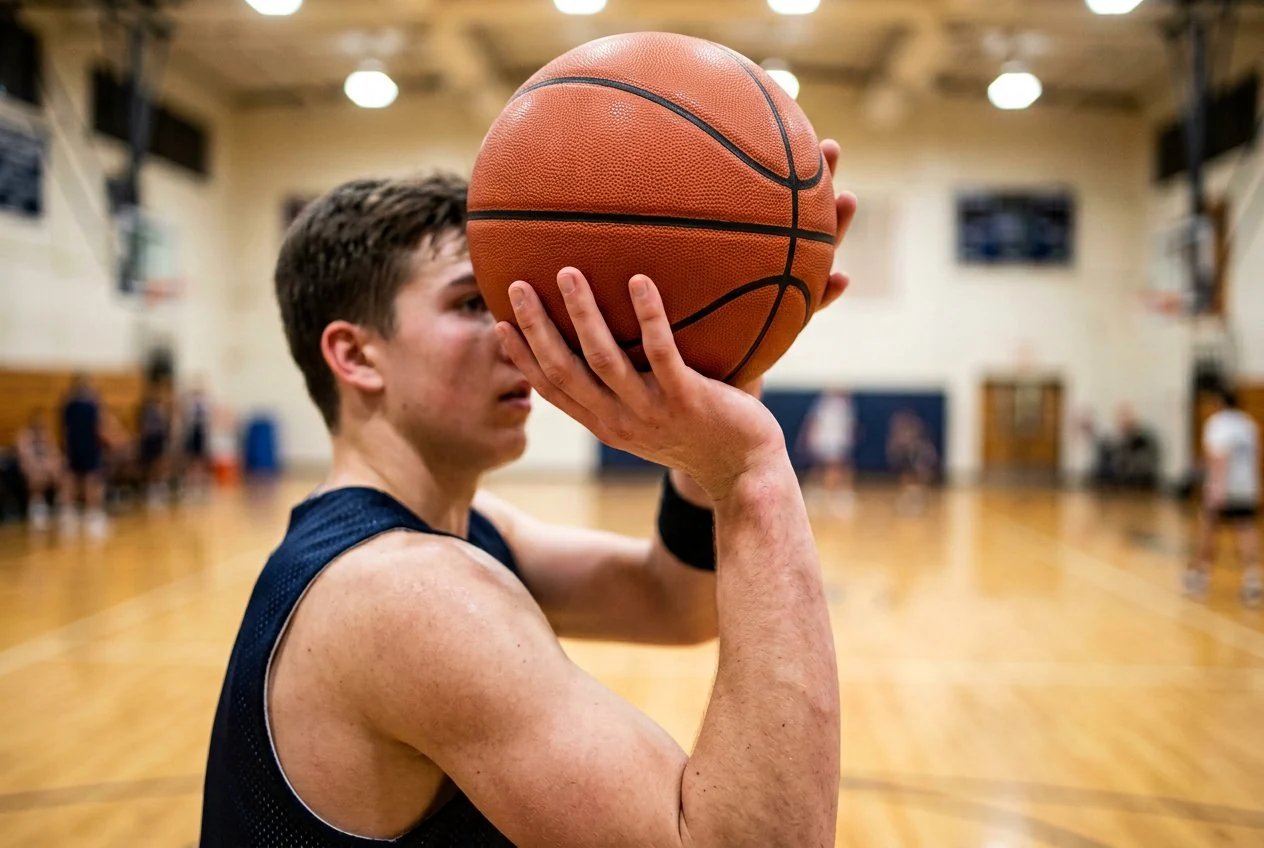
The shooting hand sits under the ball, not behind it. Fingers spread comfortably, with the ball resting on the pads of the fingers rather than deep in the palm, which allows for the fingertip control and backspin that a soft, accurate shot depends on.
The guide hand does exactly that, guides. It sits on the side of the ball for stability during the setup and release, but it shouldn’t be pushing or influencing the direction of the shot at all. A common flaw at every age is the guide hand thumbing the ball on release, which pushes shots consistently off to one side.
Elbow aligned under the ball, not flared out to the side. This is one of the most common breakdowns we see in young players, and it’s also one of the more fixable ones with consistent repetition and feedback, since a flared elbow sends the ball on an inconsistent line shot after shot.
The Release and Follow Through
A high release point, generally above the forehead, gives the shot a better arc and is harder to contest. Younger players with less strength sometimes release from lower, closer to the chest, which is a normal developmental stage rather than a flaw to panic about, but it’s worth progressing toward a higher release as strength develops.
Full extension of the arm at release, finishing with the wrist snapped forward. This is what generates the backspin that helps a shot roll favourably off the rim rather than bouncing away unpredictably, and it’s a detail that’s easy to shortcut under fatigue.
Holding the follow through, wrist bent forward, fingers pointed toward the basket, until the ball reaches the rim. This single habit, holding the follow through rather than dropping the arm immediately after release, is one of the simplest and most effective corrections for inconsistent shooters of any age.
Rhythm and Timing
A consistent, repeatable rhythm from catch to release matters as much as any individual mechanical piece. A shot that’s mechanically sound but rushed, or where the timing between the legs, the load, and the release varies shot to shot, will still miss inconsistently even with good individual pieces.
The shot should flow as one continuous motion, not a series of separate steps. Catch, load, and release blending smoothly together produces a considerably more consistent shot than a choppy, segmented motion where a player visibly pauses between phases.
Building Form Through Repetition
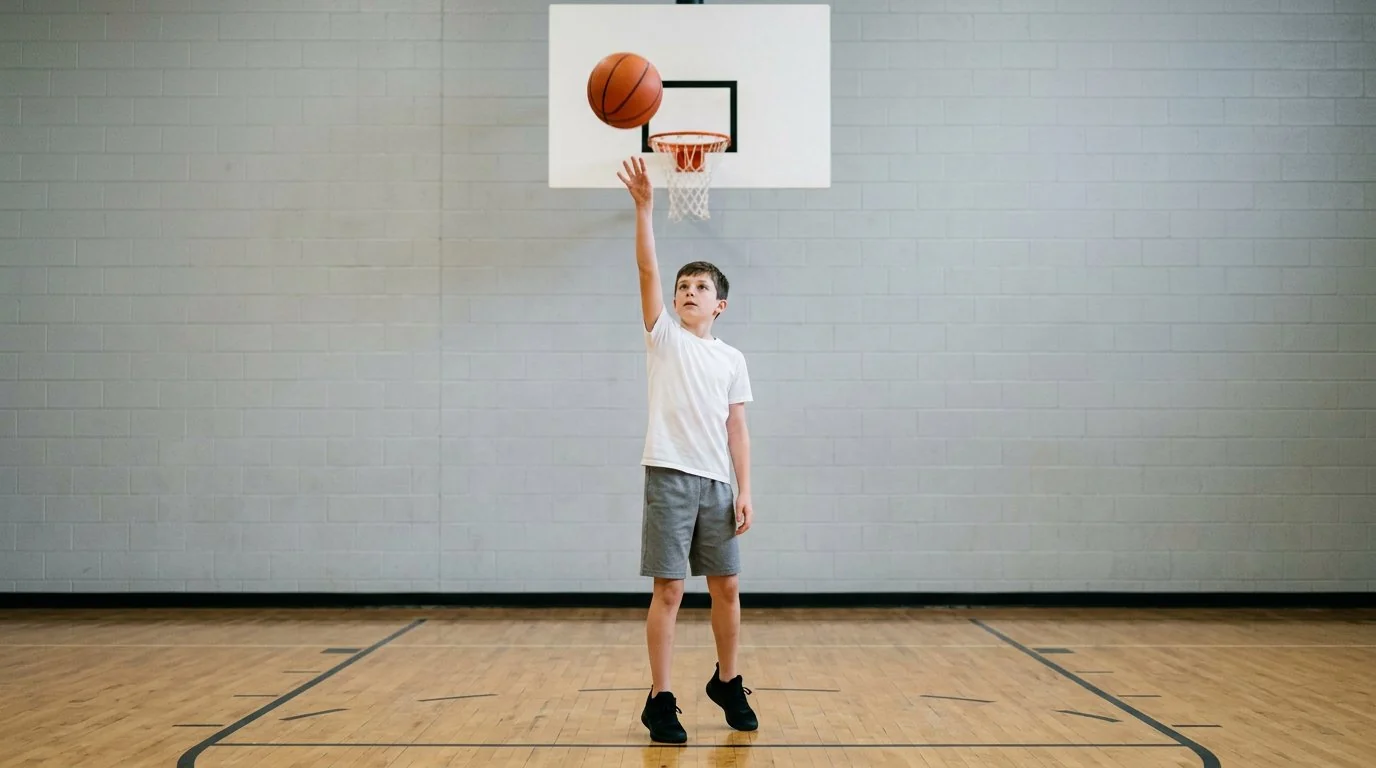
Close-range, form-focused repetition before adding distance or speed. Starting close to the basket, focusing purely on mechanics without worrying about makes and misses, lets a young player groove the correct pattern before adding the complexity of distance, a defender, or game speed.
Video feedback helps enormously, even a phone propped up during a shooting session. Players, and sometimes coaches, are often surprised by what an actual recording reveals compared to what the shot felt like in the moment.
Consistency over volume. A shorter, focused session with genuine attention to form beats a long session of mindless repetition that reinforces whatever flaws are already present.
At YouHoop, shooting fundamentals are built into our regular sessions through deliberate, focused repetition, not left to develop by accident. Our skill training classes work through exactly this progression, starting close and building outward as mechanics solidify. You can read more about our approach on our about page, and book a welcome call with our team if you’d like to talk through your player’s shooting development specifically.

0 Comments