Basketball dribbling drills are the foundation of every complete basketball player regardless of position, age, or level of competition. The ability to handle the ball under pressure, change direction without telegraphing the move, and use both hands with equal confidence and control is what separates players who can only function when the defense gives them room from players who create their own advantages no matter what the defense does.
Most players practice dribbling but very few practice it deliberately. They do the same crossover drill they have always done, at the same pace, in the same amount of space, without increasing the difficulty as their skill improves. This feels like work but it produces very little improvement because the drill is no longer challenging enough to drive adaptation. Real improvement in basketball dribbling drills comes from deliberate practice with progressively increasing difficulty, specific focus on the mechanics that limit performance, and consistent repetition of game-speed movement patterns.
This guide covers the most effective basketball dribbling drills for players at every developmental stage, how to structure a ball handling practice session, and the specific progressions that move players from basic control to game-ready dribbling skill.
1. Why Dribbling Is the Most Important Individual Skill in Basketball
The ability to handle the ball under pressure determines what options a player has in every offensive possession. A player who cannot dribble with their weak hand is a player every defense can overplay to one side and take away half the floor. A player who loses the ball under defensive pressure is a player coaches cannot trust in important possessions. A player whose dribble is too high, too slow, or too predictable is a player who creates advantages for the defense rather than for their team.
Conversely the player who can handle the ball at game speed with both hands, who maintains control under contact, who can change direction convincingly without telegraphing the move, and who can make decisions while dribbling rather than before or after, is a player every defense has to respect. That respect is what creates advantages for teammates. It opens driving lanes. It forces defensive rotations. It makes the entire offense more dangerous.
Basketball dribbling drills done correctly build this kind of player over time. It does not happen quickly. But it happens predictably when the practice is deliberate and consistent.
2. The Fundamentals Every Player Must Master Before Advanced Dribbling
Before any player should progress to complex basketball dribbling drills they need to demonstrate control of the fundamentals that every advanced move is built on. These are the foundational habits that need to be in place.
Dribble height. The ball should be kept below the hip in most game situations and close to the knee when under defensive pressure. High dribbles are easy to steal. Low dribbles are protected by the body and much harder to deflect.
Head up. Every dribbling drill should be practiced with the head up and eyes forward rather than watching the ball. Players who cannot dribble without watching the ball cannot see the floor, cannot make decisions, and cannot use dribbling as a platform for team play.
Fingertip contact. The ball is controlled through the fingertips not the palm. Fingertip contact gives the hand sensitivity to feel and react to the ball quickly. Palm contact is slow and imprecise.
Weak hand development. The single most important principle in basketball dribbling drills for developing players is that every drill done with the strong hand must be done with the weak hand. A player who only practices with their dominant hand is building half a skill. Building the weak hand to genuine game ready competence is what takes a limited player and makes them genuinely hard to guard.
Body positioning. An athletic stance with knees bent, weight on the balls of the feet, and the body between the ball and the defender is the defensive position for the ball in every dribbling situation. Players who dribble upright are easy to pressure. Players who dribble in a low athletic stance are difficult to guard.
3. Basketball Dribbling Drills: The Proven 7-Drill Progression System
3.1 Stationary Dribbling Series
Stationary basketball dribbling drills are the starting point for players at the foundation stage and the warm-up for players at every level. The goal of stationary dribbling work is to build the mechanical habits of fingertip contact, low dribble height, and head up positioning before adding movement.
Basic stationary series: Right hand low dribble 30 seconds. Left hand low dribble 30 seconds. Alternating hand pound dribble 30 seconds. Right hand high to low dribble changing height on each bounce 30 seconds. Left hand high to low 30 seconds.
Advanced stationary series: Two ball simultaneous dribble 30 seconds. Two ball alternating dribble 30 seconds. Two ball crossover simultaneous 30 seconds. Behind the back two ball alternating 30 seconds.
Two ball dribbling forces the eyes up because neither hand can watch the ball. It is one of the most effective tools for building head up dribbling habits in players who struggle to keep their eyes off the ball.
At You Hoop, we use stationary dribbling series as the opening five minutes of every individual skill session because it calibrates the mechanics before any movement is added. See our Skill Class page for how we structure individual development sessions.
3.2 Full Court Ball Handling Series
Full court basketball dribbling drills combine ball handling with movement, building the ability to control the ball while the feet are doing something at the same time.
Basic full court series: Right hand dribble baseline to baseline. Left hand dribble baseline to baseline. Speed dribble at 70 percent pace right hand. Speed dribble at 70 percent pace left hand.
Intermediate full court series: Crossover at half court changing hands. Between the legs at half court. Behind the back at half court. Figure eight dribble while walking forward.
Advanced full court series: Two ball speed dribble full court. Two ball crossover every five steps. Combination move sequences at pace including crossover, between the legs, behind the back in a continuous sequence.
The full court series should always be done with a focus on pace control. Starting at 50 to 60 percent pace with perfect mechanics and gradually building to game speed maintains the quality of movement through the entire series rather than sacrificing form for speed.
3.3 Change of Pace and Change of Direction Drills
Change of pace and change of direction are the two most important advanced basketball dribbling drills because they teach the manipulation of a defender’s positioning and timing that creates actual advantages in game situations.
Change of pace series: The hesitation move. Slow the dribble to near standing pace, hesitate with the body language of stopping, then explode past the imaginary defender. The key is the conviction of the hesitation. A hesitation that does not look like a genuine stop does not freeze a defender.
The change of pace crossover. Drive at 80 percent pace, dramatically slow the dribble, perform a low tight crossover, and immediately re-accelerate. The pace change before the crossover is what makes the crossover work. A crossover without a pace change is simply a lateral ball movement that gives a good defender time to adjust.
3.4 Cone and Obstacle Dribbling
Cone drills are among the most effective basketball dribbling drills for developing change of direction mechanics and decision-making speed because they provide a physical target that replaces the imaginary defender of open-space drills.
Basic cone series: Weave through five cones using right hand only. Weave through five cones using left hand only. Weave through cones using crossover at each cone.
Advanced cone series: Weave through cones using between the legs at each cone. Weave through cones using behind the back at each cone. Random assignment series where a coach calls the move at each cone forcing in-motion decision making.
The random assignment version of cone dribbling drills is one of the most game-specific basketball dribbling drills available because it trains decision-making during movement rather than pre-planned execution of known sequences.
3.5 Tight Space Dribbling
The ability to maintain ball control in tight spaces under simulated pressure is one of the most valuable and most overlooked areas of basketball dribbling drills. Most players can dribble well in open space. The game rarely provides open space.
Tight space drills: Box dribbling. Confine all dribbling within a small box marked by cones. The player must continuously change direction to avoid leaving the box while maintaining control. This builds the short, tight change-of-direction mechanics that are essential for handling ball pressure in games.
Partner shadow dribbling. A partner mirrors every movement without attempting to steal the ball. The presence of another moving body develops the spatial awareness and tight dribbling mechanics that open-space drills cannot replicate.
3.6 Finishing Drills off the Dribble
Finishing basketball dribbling drills connect the ball handling work to the scoring actions that give dribbling its game value. A player who can dribble well but cannot finish at the rim has a skill with no payoff.
Basic finishing series: Right hand layup off right side dribble approach. Left hand layup off left side dribble approach. Crossover into right hand layup from the left. Between the legs into left hand layup from the right.
Advanced finishing series: One dribble pull-up jumper from the elbow. Two dribble pull-up from the wing. Crossover pull-up from the top of the key. Floater finish off one dribble drive from the short corner.
These finishing basketball dribbling drills combine ball handling with decision-making and shooting mechanics, building the complete offensive skill set that makes dribbling threatening to defenses rather than simply impressive in isolation.
3.7 Pressure Dribbling and Competitive Drills
Competitive basketball dribbling drills are the most game-specific training available because they add the defensive pressure, the physical contact, and the decision-making demands of actual game situations.
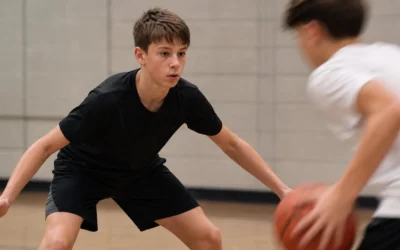
Pressure series: One on one dribble keep-away. The dribbler attempts to maintain possession for 30 seconds without crossing a half-court boundary while the defender attempts to knock the ball away. This builds the body control, low dribble, and change of direction skills that open space drills cannot develop.
Dribble obstacle course competition. Two players compete to complete an identical obstacle course in the shortest time. The competitive element elevates intensity and effort to game levels.
According to research on skill acquisition in basketball published by the International Journal of Sports Science and Coaching, deliberate practice that progressively increases difficulty and introduces competitive elements produces significantly faster skill development than repetitive practice at a fixed difficulty level. Basketball dribbling drills must be progressively more challenging to continue driving improvement.
4. How to Structure a Basketball Dribbling Practice Session
A well-structured basketball dribbling drills session builds from foundation to advanced systematically so that every component prepares the player for the next.
Minutes 1 to 5: Stationary dribbling warm-up building mechanical habits. Minutes 5 to 15: Full court ball handling series building control with movement. Minutes 15 to 25: Change of pace and direction drills. Minutes 25 to 35: Cone and tight space work. Minutes 35 to 45: Finishing drills combining dribbling with scoring. Minutes 45 to 55: Competitive pressure drills.
This 55-minute structure covers all components of comprehensive basketball dribbling drills development and can be used two to three times per week as a standalone session or integrated into broader skill development sessions.
For more on how we structure complete skill development sessions at You Hoop see our About page and book your session to get started.

0 Comments