How to get better at basketball at home is the question every player who wants to improve faster than their competition is asking. The gym session is great. The team practice is important. But the players who separate themselves from the rest of the roster are the ones who figure out how to keep developing between official sessions, in their driveway, their garage, or any small space they can find.
The truth about home basketball training is that most players do it wrong. They shoot around casually, dribble without a specific purpose, and call it a workout. This feels productive because there is a ball in their hands and they are moving. But unfocused repetition builds habits rather than improvements. And if the habits being built are sloppy, they are making the wrong things automatic.
This guide covers exactly how to get better at basketball at home in a way that actually transfers to game performance, what equipment you need and what you absolutely do not need, and how to build a home training routine that produces measurable improvement in your game.
1. Why Home Training Is Where Real Improvement Happens
The team practice is where the coach teaches. The game is where skills are tested. But home training is where skills are actually built. The difference between the player who improves dramatically from one season to the next and the one who stays at the same level is almost always what they do in the time between organised sessions.
The players who figure out how to get better at basketball at home are compounding their development on top of the team environment. A player who adds three quality home training sessions per week to their team practice and game schedule is getting roughly double the deliberate skill work of a player who only shows up for organised sessions. Over a full season, over a full year, this compounds into a development gap that talent alone cannot close.
The key word is quality. Three hours of unfocused shooting around produces far less improvement than 45 minutes of deliberate, specific, progressive home basketball training. The volume matters far less than the intent and the structure behind it.
2. What You Actually Need to Train at Home
One of the biggest misconceptions about learning how to get better at basketball at home is that you need significant space and equipment. You do not.
What you need: A basketball. A hard surface of any kind. Approximately 10 to 15 feet of space. A hoop if you have one, but many of the highest-value home drills do not require a basket at all.
What you do not need: An indoor court. A full-size basketball hoop. A rebounder. Training cones. An agility ladder. All of these are useful additions if you have them. None of them are required to run a serious home basketball training session that produces real game improvement.
The players throughout history who developed elite ball handling skills often did so in driveways, small yards, and hallways. The space and equipment are not the limiting factor. The intent and the consistency are.
3. How to Get Better at Basketball at Home: The Proven 6-Component Training System
3.1 Weak Hand Development: The Highest Leverage Thing You Can Do
If you want to know the single most impactful thing you can do when training at home for basketball, this is it. Isolated weak hand dribbling. Every session. Without fail.
A player who can only go right is a player every defense at every level above youth recreation can stop with a single defender. A player who goes equally well in both directions requires two defenders to contain and that opens every other offensive skill they have. The weak hand is where the biggest development gap exists for most players and it is entirely closeable with focused home training.
Weak hand daily protocol: Start every home training session with 5 minutes of exclusive weak hand stationary dribbling before touching the ball with the strong hand. This is not negotiable. Crossovers, between the legs, behind the back all come later. For the first 5 minutes the strong hand stays behind the back and the weak hand does everything.
At You Hoop we build weak hand isolation into every skill development session because we know from watching hundreds of players develop over years that this single habit separates the players who arrive at tryouts with a complete offensive game from those who have a tell that every defender targets.
3.2 Stationary Ball Handling Series
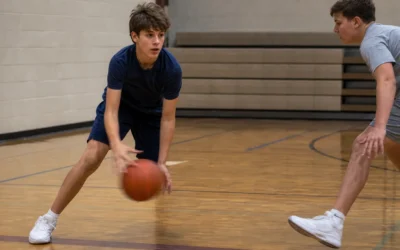
Stationary ball handling is the foundation of all court ball handling and can be done in any space including indoors. A full stationary ball handling series takes 15 to 20 minutes and develops the hand strength, coordination, and muscle memory that makes every dribble move faster and more reliable under pressure.
Basic stationary series for home basketball training:
Low dribbles in front with the strong hand for 30 seconds. Low dribbles in front with the weak hand for 30 seconds. Alternating hand dribbles for 30 seconds. Crossover dribbles in place for 30 seconds. Between the legs front to back for 30 seconds. Behind the back dribbles for 30 seconds. Figure eights around both legs for 30 seconds.
Complete the entire series twice through. As this becomes comfortable add a second ball for two-ball versions of each exercise.
The most important coaching point for stationary ball handling at home: Keep the head up throughout. Looking down at the ball during stationary work builds the habit of looking down with the ball during game work. Every rep of head-up dribbling makes game head-up dribbling more natural.
3.3 Form Shooting Close to the Basket
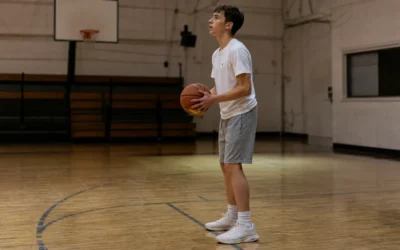
If you have a hoop at home, near home, or can access one, form shooting is the second most impactful thing you can do in a home training session. Not shooting from distance. Not shooting with game intensity. Form shooting from 3 to 5 feet directly in front of the basket with complete focus on mechanics.
The purpose of form shooting is to build the correct neural pathway for your shot at a distance where the mechanics can be executed perfectly without any compensations for distance or fatigue. Every repetition of perfect mechanics at close range makes those mechanics more available when the shot is contested, off the dribble, and from distance in a real game.
Form shooting protocol:
10 shots from directly in front at 3 feet focusing on hand placement and follow through. 10 shots from 5 feet focusing on leg drive and elbow alignment. 10 shots from 8 feet as the transition point to spot shooting. Make 8 of 10 from each distance before moving back.
For the complete shooting development system that home form shooting feeds into see our How to Improve Basketball Shooting Skills guide.
3.4 Spot Shooting: Building Consistency From Game Locations
Once form shooting has calibrated the mechanics, spot shooting from game-relevant locations builds the consistency that makes you a genuine shooting threat in competition. Spot shooting at home requires a hoop but is otherwise one of the most straightforward and most productive training activities available.
Spot shooting home protocol:
Choose 5 spots around the arc or from the mid-range area depending on your current range. Take 10 shots from each spot before moving. Track makes and attempts from each spot every session. Your goal is 70 percent or better from each spot. Any spot below 70 percent gets extra time the following session.
The tracking is as important as the shooting. Players who track their percentages know exactly which spots need work. Players who shoot without tracking are working without information.
3.5 Footwork Without a Ball
The most underutilised home basketball training activity. Footwork drills done without a ball develop the movement patterns that are the foundation of every offensive and defensive action in the game. They require no equipment and minimal space.
Footwork drills for home basketball training:
Triple threat positioning and pivot practice. Plant and cut mechanics done against a wall or in a hallway. Defensive slide series for 30 to 45 seconds. Closeout footwork, the sprint and deceleration mechanics of closing out on a shooter. Jab step and drive footwork from the triple threat.
10 to 15 minutes of focused footwork without a ball develops movement habits that transfer directly to game situations. A player whose footwork is correct and automatic has a foundation that makes every ball handling and shooting skill significantly more effective.
For more on footwork development as part of a complete player development approach see our Basketball Player Development for Kids guide.
3.6 Mental Visualisation
The most overlooked component of how to get better at basketball at home and one of the most research-supported. Mental visualisation of basketball skills activates virtually the same neural pathways as physical practice of those skills. Elite athletes across every sport use visualisation as a deliberate training tool. Youth basketball players almost never do.
A practical visualisation protocol for home basketball training:
5 minutes at the end of every home training session. Sit comfortably with your eyes closed. Visualise yourself executing your strongest skills in game situations with perfect mechanics and total confidence. Visualise responding to a missed shot or a turnover with composure and competing on the next possession. Visualise the specific skills you are working on in your training looking and feeling automatic.
This is not wishful thinking. It is deliberate mental rehearsal that complements physical practice and accelerates the rate at which skills become automatic.
According to research published by the Journal of Applied Sport Psychology on mental rehearsal in sport, athletes who combine physical practice with structured mental visualisation demonstrate significantly faster skill acquisition and better performance under competitive pressure than those who rely on physical practice alone.
4. Building a Weekly Home Training Routine
Consistency is the most important factor in getting better at basketball at home. Three quality 40-minute sessions per week produces far more development than one two-hour session when motivation peaks.
A practical weekly home training routine:
Monday: 5 minutes weak hand isolation. 15 minutes stationary ball handling series. 15 minutes form and spot shooting. 5 minutes footwork.
Wednesday: 5 minutes weak hand isolation. 20 minutes two-ball stationary series and advanced handles. 10 minutes shooting. 5 minutes visualisation.
Friday or Saturday: 5 minutes weak hand isolation. 10 minutes stationary handles. 20 minutes spot shooting or shooting off movement if you have access to a gym. 5 minutes footwork.
This routine requires 40 minutes per session and no equipment beyond a basketball. It addresses every component of the game that can be developed at home and is structured progressively to produce consistent measurable improvement.
For the complete development pathway that home training feeds into see our Off Season Basketball Training Program guide and our Youth Basketball Training Program Kansas City overview. When you are ready to train with our coaches book your session.

0 Comments