Basketball IQ training is the most overlooked dimension of youth player development — and the one that most consistently separates players who reach their ceiling from those who fall short of it. Talent fills gyms. Basketball IQ fills stat sheets, earns playing time, and translates to every level of competition a player reaches throughout their career.
A player with average athleticism and elite basketball IQ will outperform a highly athletic player with low basketball IQ at almost every level above recreational ball. That is not a coaching opinion. It is what coaches at every level of the game observe and talk about constantly. The players who make every teammate better, who seem to always be in the right place, who make the right decision before the defense has time to react — those players are not simply gifted. They have developed a specific, trainable set of mental skills that govern how they read and respond to the game.
This guide covers exactly what basketball IQ training looks like, what its components are, how it is developed at each stage of a player’s career, and what separates the player who truly understands the game from the one who is simply physically talented within it.
1. What Basketball IQ Actually Is and Why It Matters
Basketball IQ is not a single skill. It is a collection of interconnected mental abilities that together determine how well a player understands, reads, and responds to the game in real time.
It includes the ability to read defensive alignments before making a decision. The awareness of where teammates are and where they are going before the ball arrives. The understanding of when to attack, when to reset, and when to make the simple play rather than the spectacular one. The anticipation of opponent tendencies based on what has happened earlier in the game. The knowledge of what a defense is trying to take away and how to exploit what it is giving.
None of these abilities are natural in the way that height or athleticism are natural. They are all learned. They develop through quality coaching, deliberate practice, competitive experience at appropriate levels, film study, and the habits of attention and analysis that some players develop and most do not.
Basketball IQ training is the deliberate process of developing these abilities — not hoping they emerge through game experience alone, but actively building them through specific coaching interventions, structured learning, and the kind of reflective practice that turns game experience into game wisdom.
2. Why Most Youth Programs Fail to Develop Basketball IQ
The reason basketball IQ training is so widely neglected in youth basketball comes down to a fundamental tension in how most programs are structured. Games produce measurable outcomes immediately. IQ development produces outcomes slowly, invisibly, and over long time horizons. In a win-oriented environment with parents watching from the stands, coaches face enormous pressure to prioritize the former at the expense of the latter.
The result is that most youth basketball programs produce athletes who have played a lot of basketball without necessarily understanding it deeply. They have accumulated game experience without the coaching interventions that convert experience into insight. They have competed in hundreds of possessions without ever being taught to analyze what happened and why.
The programs that genuinely invest in basketball IQ training produce players who look increasingly different from their peers as they advance. At 8th grade the athletically gifted player who has never been taught to read the game can still dominate youth competition on physical tools alone. By 10th grade the player with genuine basketball IQ has passed them. By 12th grade the gap is enormous.
3. Basketball IQ Training: The Proven 7-Component Development System
3.1 Court Vision and Spatial Awareness
Court vision is the ability to see the entire floor — all ten players, all passing lanes, all defensive positions — rather than just the ball and the immediate defender. It is the foundation of basketball IQ training and the quality that separates truly great players from very good ones at every level.
Court vision is not a gift. It is a developed habit of looking at the right things at the right moments. Players who grow up dribbling with their heads down because they are focused on the ball never develop court vision. Players who are coached from the beginning to keep their head up, scan the floor before making decisions, and locate teammates before receiving the ball develop it progressively over time.
Court vision development drills:
- Dribbling with head up while identifying the number of fingers a coach holds up at various positions on the floor
- Two ball dribbling to free the eyes from tracking a single ball
- Catch and scan before shoot drills where a player must identify a defensive position before making the shot decision
- Color-coded spacing drills where teammates wear different colored pinnies and players must identify color combinations before making passes
At You Hoop, court vision is coached deliberately from the earliest stage of our program because we know that the habit of seeing the whole floor is built early or not at all.
3.2 Reading Defensive Alignments
Every offensive decision a smart player makes is based on what the defense is doing. A player who attacks the same way regardless of the defensive alignment is a player the defense can stop predictably. A player who reads the defense and attacks the right way based on what it is giving them is a player the defense has to solve every possession.
Basketball IQ training at the defensive reading level means teaching players to identify the most common defensive coverages — man to man, zone, help-side rotations, ball screen coverages — and to understand what each coverage is designed to take away and what it leaves open.
Key defensive reading concepts for basketball IQ training:
- Identifying man versus zone before the offense runs any action
- Reading help-side positioning to identify when a drive will draw help and when it will not
- Understanding ball screen coverages — hedge, drop, switch, blitz — and the correct offensive response to each
- Recognizing defensive rotations after the initial action and exploiting second-side opportunities
This level of basketball IQ training requires patient coaching that explains the why behind every decision rather than simply drilling the what. Players who understand why a certain action creates an advantage can apply that principle in novel situations. Players who only know the play cannot adapt when the defense adjusts.
3.3 Passing IQ and Decision Making
The pass is the most important skill in basketball team offense and the one that most clearly reveals a player’s basketball IQ. A player who always makes the easy, correct pass — who never holds the ball when it should move, never forces a pass into coverage, and always delivers the ball where the receiver can use it — is a player whose basketball IQ makes everyone around them better.
Basketball IQ training in the passing context means developing the ability to make correct decisions quickly, to see the play two passes ahead, and to understand the difference between a pass that generates an advantage and one that simply moves the ball.
Passing IQ development methods:
- 3-on-2 and 2-on-1 breakdown drills with strict rules about reading and passing in advantage situations
- Skip pass recognition drills where players must identify when the ball should skip rather than swing
- Passing under time pressure to build quick decision-making habits
- Teaching the concept of the extra pass — when and why the second pass after the first creates a better shot than the first pass itself
Our coaches at You Hoop teach passing IQ as a specific skill because we know that a player who makes great decisions with the ball is more valuable at every level of the game than one who simply makes plays for themselves. Learn more about our approach on our About page.
3.4 Offensive Spacing and Movement
Basketball IQ training must include a thorough understanding of offensive spacing — why certain floor positions create advantages and why others collapse the offense. A team where every player understands spacing plays with five threats on the floor simultaneously. A team where no one understands spacing plays with one or two — and those players spend most of their offensive possessions fighting through traffic created by their own teammates.
Spacing principles every player should understand:
- The three point line as the floor spacing boundary — players who stand inside it collapse the driving lane for teammates
- Corner spacing and the importance of the corner three as the floor extender in modern basketball
- Weak side spacing and why a cutter must replace the spot they vacated to maintain floor balance
- Why dribble penetration requires teammates to move away rather than toward the ball
Teaching these concepts requires coaches who understand spacing deeply enough to explain it simply and to correct spacing mistakes in real time during practice. The players who graduate from programs that have taught spacing consistently arrive in high school with a sophisticated understanding of team offense that players from less developed environments simply do not have.
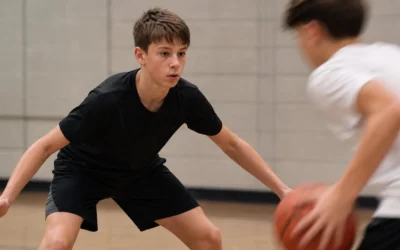
3.5 Defensive IQ and Team Defense Concepts
Basketball IQ training is not limited to the offensive end of the floor. Defensive intelligence is equally important and equally developable — and at the highest levels of the game it is often the dimension that determines which players earn playing time regardless of their offensive ability.
Core defensive IQ concepts for youth players:
- Helpside positioning — where to stand when your player does not have the ball so that you can both guard your player and help teammates
- Understanding defensive rotations — who rotates to what position when a defender gets beaten off the dribble
- Communication as a defensive skill — calling out screens, defensive assignments, and rotations so that teammates can make adjustments in real time
- Taking charges versus blocking shots — understanding when to stand firm and when to contest in the air
Defensive IQ training requires that coaches value defense enough to teach it as deliberately as they teach offense. Programs that spend 80 percent of practice time on offense and rely on effort alone for defense do not develop defensive IQ. The habits of positioning, communication, and rotation awareness must be drilled specifically and consistently to become automatic.
3.6 Film Study: The Fastest Way to Accelerate Basketball IQ
Film study is the most underused basketball IQ training tool available to youth players. Watching film — either of their own games or of high-level play — with a specific analytical purpose accelerates basketball IQ development faster than an equivalent amount of time on the court because it allows for reflection, pattern recognition, and learning from mistakes without the real-time pressure of game execution.
Effective film study for youth players:
- Self-film review with a specific focus: watch only defensive possessions, or only transition decisions, or only ball screen reads — not the whole game indiscriminately
- Watching college or professional players at the same position specifically to observe decision-making, not highlight plays
- Coach-led film sessions where a coach pauses and asks questions rather than lecturing — “what did you see here, what would you do differently?”
- Identifying patterns in opposing teams’ tendencies that can be exploited in upcoming games
Even 15 to 20 minutes of purposeful film review per week produces meaningful basketball IQ gains over a season because it forces the reflective thinking that converts game experience into game wisdom. Most youth players never watch film. The ones who do gain an enormous analytical advantage over time.
3.7 Game Speed Decision Making
All of the basketball IQ developed through drills, film, and coaching interventions must eventually be expressed at game speed — in the fraction of a second available between receiving the ball and needing to act. Basketball IQ training that only happens at slow practice speed does not transfer to games.
Building game speed decision-making requires practicing decisions at game speed in competitive contexts. Scrimmages with specific rules that force particular decisions. 5-on-5 play with restrictions like no dribbles allowed on ball reversals to force quick passing reads. Competitive drills where a correct decision scores and an incorrect one costs the team a point.
The goal is to compress the gap between reading a situation and responding to it — to build the neural patterns that recognize common game scenarios and trigger the correct response automatically rather than requiring conscious thought in the heat of competition.
According to research on expert performance in sports by the Journal of Sports Sciences, elite athletes demonstrate significantly faster and more accurate pattern recognition in game-relevant scenarios than novices — and this pattern recognition is developed through deliberate, sport-specific experience rather than through general intelligence or natural ability. Basketball IQ training is the deliberate process of building exactly these patterns.
4. Basketball IQ Training at Each Developmental Stage
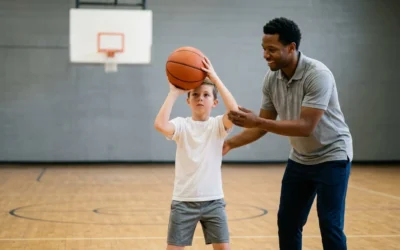
Foundation stage (3rd through 5th grade). At this stage basketball IQ training focuses on the habits of attention that make everything else possible: keeping the head up while dribbling, scanning the floor before making decisions, and understanding the basic spacing principle that players should spread out rather than bunch together. These habits, built correctly at this stage, make every subsequent layer of IQ development faster and more effective.
Development stage (6th through 8th grade). This is when basketball IQ training becomes more sophisticated and more explicitly coached. Defensive alignments, passing reads in advantage situations, helpside positioning, and offensive spacing concepts all become active development priorities. Film study introduced at this stage as a regular habit produces dramatic IQ gains over a full season. Players who emerge from this stage with genuine basketball IQ are qualitatively different from their peers in high school.
Performance stage (9th through 12th grade). Basketball IQ training at this stage focuses on advanced concepts — ball screen coverages and counters, late game situations, reading tendencies within games to exploit adjustments, and the leadership dimensions of IQ that involve communicating reads to teammates in real time. Players with high basketball IQ at this stage are the ones who consistently attract college coaching attention regardless of their raw athletic profile.
5. How to Develop Basketball IQ Outside of Practice
Basketball IQ training does not have to be limited to time on the court. These are the most effective ways a player can develop basketball IQ independently.
Watch basketball with intention. Watching games on television with a specific analytical focus — studying how a particular player moves without the ball, how a team defends ball screens, how a point guard reads and reacts to defensive rotations — develops pattern recognition faster than passive watching. One game watched analytically is worth more than ten games watched casually.
Play pickup with better players. Playing with and against players who are more experienced and more skilled than you forces rapid adaptation. The pace is faster, the decisions are harder, and the consequences of poor decisions are immediate. Pickup ball with better players is one of the most efficient basketball IQ training environments available at any age.
Talk basketball with coaches and knowledgeable players. Asking coaches why certain things happen in games — why a team switched to a zone, why a player made a particular cut, what the right decision was in a specific situation — activates the analytical thinking that builds IQ. Players who are curious about the game develop it faster than players who simply execute instructions.
For more on how our program at You Hoop develops basketball IQ alongside technical and physical skills, see our Skill Class page and book your session to get your athlete into our development environment.

0 Comments