5 Fun and Effective Basketball Drills for Solo Practice

Basketball drills are essential for improving your skills, whether you’re on a team or practicing solo. While team practices often focus on group activities, solo practice allows you to refine specific aspects of your game, boosting your skill set and confidence. Here are 5 fun and effective basketball drills that you can easily do alone to take your game to the next level.

1. Shooting Drills: Perfecting Your Shot with Basketball Drills

One of the most important aspects of basketball is shooting. Whether you’re practicing free throws or jump shots, focusing on your shooting form is critical. A simple yet effective drill for solo practice is the Spot Shooting Drill. How to do it:
     
      • Start by choosing spots on the court: one at the free-throw line, one at the corner, and one at the top of the key.
      • Take 10 shots from each spot, aiming to make at least 7 out of 10 shots.
      • Focus on your form: Keep your elbow in, and knees bent, and follow through after each shot.
      • If you miss a shot, go back to your starting position and try again.
    This basketball drill not only helps with shooting accuracy but also builds mental toughness and consistency.

    2. Dribbling Drills: Improve Your Ball Handling with Basketball Drills

    Strong ball-handling skills are a must for any basketball player. Dribbling drills help you maintain control of the ball, make quick changes of direction, and break down defenses. One effective solo dribbling drill is the Cone Dribble Drill. How to do it:
       
        • Set up 5 cones or obstacles in a zigzag pattern on the court.
        • Dribble the ball through the cones, making sure to keep your head up and maintain control at all times.
        • Focus on using both hands, switching between your left and right hand as you weave through the cones.
        • Once you reach the last cone, sprint back to the starting point and repeat the drill.
      The basketball drills in this drill enhance both your dribbling speed and agility, allowing you to break past defenders easily.

      3. Passing Drills: Strengthen Your Passing with Basketball Drills

      Passing is often an underappreciated skill in basketball, but it’s essential for moving the ball and setting up plays. One great solo drill for improving your passing is the Wall Pass Drill. How to do it:
         
          • Stand about 5-10 feet away from a solid wall, holding the ball in both hands.
          • Throw the ball against the wall with enough force that it bounces back to you.
          • Focus on quick, sharp passes and catching the ball with your fingers, not your palms.
          • Perform chest passes, bounce passes, and overhead passes, aiming for accuracy and speed.
        By regularly practicing this basketball drill, you’ll not only strengthen your passing technique but also improve your reaction time and hand-eye coordination.

        4. Footwork Drills: Enhance Your Defensive Movements with Basketball Drills

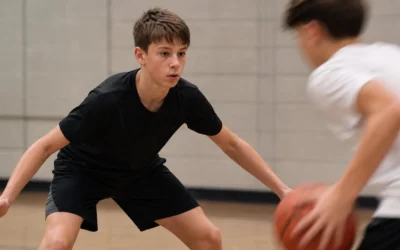
        Good defense starts with solid footwork. Improving your defensive positioning and quickness on the court is vital, and one drill that helps develop this skill is the Defensive Slide Drill. How to do it:
           
            • Stand in a defensive stance, keeping your feet shoulder-width apart and your knees bent.
            • Slide laterally to your left for 5 steps, then return to the starting position.
            • Repeat the drill by sliding to the right.
            • Increase your speed as you improve, focusing on staying low and maintaining good posture.
          This basketball drill is crucial for building the lateral movement required for effective defense. Strong footwork enhances your ability to guard opponents and react quickly to changes in the game.

          5. Conditioning Drills: Boost Your Endurance with Basketball Drills

          Basketball requires both physical and mental stamina. To build endurance and ensure you can perform at your peak throughout a game, conditioning is key. One useful drill for conditioning is the Suicide Drill. How to do it:
             
              • Start at the baseline of the court. Sprint to the free-throw line and touch it, then sprint back to the baseline.
              • Sprint to half-court, touch it, and return to the baseline.
              • Repeat the drill, running to the opposite free-throw line and then the opposite baseline.
              • Finish by sprinting to the far end of the court and back to the baseline.
            This high-intensity basketball drill is great for building stamina and improving your overall conditioning. Check out more effective basketball training tips and drills to continue improving your skills and reaching your full potential.

            Conclusion:

            These basketball drills are fun, effective, and easy to incorporate into your solo practice. They target key areas of your game, such as shooting, dribbling, passing, defense, and conditioning, ensuring that you develop a well-rounded skill set. Remember, consistent practice is the key to improvement—so commit to doing these drills regularly, and watch your basketball skills soar! You can learn about our dual-objectives philosophy that prioritizes growth, resilience, and winning in life.

            CLAIM YOUR FREE SESSION!

            ENHANCE YOUR SKILL AND UNLOCK YOUR POTENTIAL.

            Try us out for FREE and receive your custom evaluation.

            Frequently Asked Questions

            How do I know if my child's coach is truly bad or just strict?

            The key distinction is whether the coaching behaviour, however challenging, is in service of athlete development or in service of something else. A strict coach who demands high standards, gives critical feedback, and holds athletes accountable to expectations is likely, however uncomfortable, developing your child. A coach who uses humiliation as a tool, shows clear favouritism without developmental rationale, or makes athletes feel genuinely unsafe is a different matter entirely.

            Should I approach the coach alone or with other concerned parents?

            Approach alone first. A group approach feels like a confrontation even when it is not intended that way and rarely produces the open, honest conversation that resolves concerns. If your individual conversation does not produce resolution and multiple families share the same concern, escalating collectively to programme leadership is appropriate.

            What if the coach retaliates against my child after I raise concerns?

            Retaliation against an athlete because their parent raised a legitimate concern is one of the clearest indicators that this is not the right programme for your child. Document specific instances with dates and descriptions. Bring these to programme leadership immediately. A programme that permits coaching retaliation against athletes is one that does not meet the standards of a development-first youth basketball environment.

            Is it ever appropriate to pull my child from a session because of a coaching concern?

            Removing a child from an active session because of a disagreement with a coaching approach is generally counterproductive and teaches children that authority can be overridden by parental intervention whenever it is uncomfortable. The appropriate response to in-session concerns is to document what you observe and raise it through the proper process after the session. The exception is a genuine immediate safety concern that requires intervention in the moment.

            How do I help my child if they have lost confidence because of negative coaching?

            Confidence lost through negative coaching is rebuilt through positive competitive experiences in environments where the athlete receives genuine, specific encouragement for their effort and growth. More individual skill work in low-pressure contexts, more time in environments where they feel competent and valued, and a patient rebuilding of the specific skills that feel most fragile are the practical approaches. Time in the right programme environment with coaches who genuinely invest in every athlete heals this damage faster than almost anything else.

            Related Posts

            Comments

            0 Comments

            Submit a Comment

            Your email address will not be published. Required fields are marked *