Basketball speed and agility training is the athletic foundation that determines whether a player can execute their basketball skills in real game situations. You can have the best shooting mechanics in the gym. You can have elite ball handling. You can have high basketball IQ. But if you cannot get to the spots on the floor where those skills become effective, cannot create the separation needed to use them, and cannot react and redirect at the speed the game demands, all of that skill has limited game impact.
Basketball speed and agility training develops the physical qualities that make every other basketball skill more valuable. First step explosiveness that creates advantage off the dribble. Lateral quickness that allows a defender to stay in front. Reactive agility that allows a player to read and respond faster than the opponent can react. Change of direction speed that makes a player unpredictable and difficult to contain. These qualities separate the player who looks skilled in practice from the one who looks dominant in games.
This guide covers exactly what basketball speed and agility training looks like at every developmental stage, which qualities to prioritise, and the specific drills that produce the biggest performance gains for youth athletes.
1. The Four Athletic Qualities Basketball Speed and Agility Training Must Develop
Basketball is not a track sport. The speed and agility qualities that determine performance in basketball are not the same as those that determine performance in a straight-line sprint. Basketball speed and agility training that develops the right qualities produces athletes who dominate game situations. Training that develops the wrong qualities produces athletes who test well in isolation but do not translate improvement to the court.
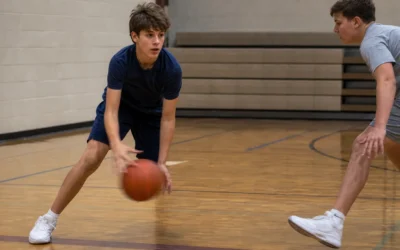
First step explosiveness. The ability to accelerate from a stationary or slow-moving position to maximum speed in two to three steps. First step explosiveness is what allows a ball handler to beat a defender off the dribble and what allows a defender to close out in time. It is the most game-impactful speed quality in basketball.
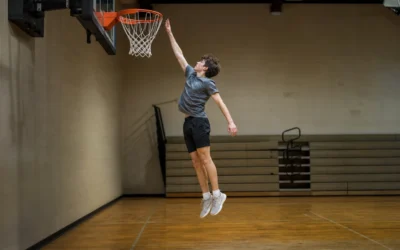
Lateral quickness and change of direction speed. Basketball is a lateral sport. More direction changes occur in a single basketball game than in almost any other team sport. The ability to move efficiently laterally, change direction without losing speed or balance, and react to an opponent’s lateral movement with equal or greater speed is the agility quality that most directly determines one-on-one defensive effectiveness.
Reactive agility. The ability to read a visual cue and initiate the appropriate movement response as quickly as possible. In basketball the cues are unpredictable because the opponent is generating them. A player with elite reactive agility anticipates the opponent’s movement and begins their response before the movement is completed. This is what makes great defenders appear to know where the ball handler is going before they go there.
Deceleration and body control. The ability to reduce speed under control and transition into the next movement without losing balance or body position. Basketball involves hundreds of accelerations and decelerations per game. The player who can stop on a mark, change direction from maximum speed, and land from jumps with body control has a quality that is both performance-enhancing and injury-protective.
2. Basketball Speed and Agility Training: The Proven 7-Exercise System
2.1 Acceleration Starts: Building First Step Explosiveness
The foundation of all basketball speed and agility training for first step development. Acceleration starts develop the explosive hip drive and arm mechanics that generate maximum speed in the first two to three steps.
Execution: Start in an athletic stance. On a signal drive explosively forward and sprint maximum effort for 10 to 15 meters. Focus entirely on the first three steps. Rest fully between repetitions. Progress to starts from defensive stance, triple threat position, and post jump landing position to simulate game-specific start positions.
Coaching points: The first step is a drive step not a lift step. The body leans forward aggressively in the first three steps. Arms drive powerfully opposite to the legs. Full effort on every repetition with full rest between.
Volume: 8 to 10 repetitions with complete rest between each. Maximum quality over quantity.
2.2 Lateral Shuffle Speed Drill
The primary basketball speed and agility training drill for lateral quickness development. Building genuine lateral speed requires repeated, progressive lateral shuffle work at maximum effort with correct mechanics throughout.
Execution: Place two cones 15 feet apart. Defensive shuffle from cone to cone touching each cone on arrival. 6 repetitions is one set. Rest 45 seconds between sets. Time the sets and track improvement over the programme.
Coaching points: No crossing of feet. Hips stay low throughout. The deceleration and direction change at each cone is as important as speed between cones. Drive from the outside foot on each change of direction.
At You Hoop lateral quickness development is a deliberate component of our competitive and elite programme training because we know that defensive effectiveness at every level above recreational basketball is primarily a function of lateral speed and agility. See our Skill Class page for how we structure athletic development within our programme.
2.3 Agility Ladder: Footwork Speed and Coordination
Agility ladder work develops foot speed, coordination, and the neural patterns that support rapid, precise foot movements in game situations.
Primary agility ladder patterns for basketball speed and agility training:
Two feet in each square develops basic coordination and foot speed. One foot in each square sprint pattern develops the alternating foot strike rhythm of running at speed. Lateral zig zag develops lateral foot speed and the step mechanics of defensive lateral movement. In-in-out-out pattern develops the specific footwork rhythm of defensive closeouts and offensive change of direction moves.
Coaching points: Precision before maximum speed. Eyes up not down at the ladder. Arm drive accompanies every leg pattern.
2.4 T-Test Agility Drill
One of the most validated assessment and training tools in basketball speed and agility training. The T-test develops forward speed, lateral speed, backward movement, and direction changes between all three in a single drill.
Setup: Four cones in a T formation. Base cone at the start. Three cones at 10 meters forward and 5 meters to each side of the center cone.
Execution: Sprint to the center cone. Shuffle left to the left cone. Shuffle right to the right cone. Shuffle back to center. Backpedal to the start. Time the completion and track improvement.
Benchmark times for high school athletes: Under 11 seconds is excellent. Under 10.5 seconds is elite level for this age group.
2.5 Reactive Cone Drill
The primary basketball speed and agility training drill for reactive agility development. Unlike programmed agility drills where the athlete knows the pattern before starting, the reactive cone drill requires reading a visual cue and initiating the correct movement in real time.
Setup: Three cones in a straight line approximately 3 feet apart. Athlete stands at the center cone.
Execution: A coach or partner points left or right randomly. The athlete reacts and sprints to the indicated cone as fast as possible. Returns to center between each signal. 10 signals per set.
Coaching points: Neutral balanced athletic stance before each signal. No leaning or committing before the cue. First step after the signal should be maximally explosive.
Progression: Add a third direction forward. Add a secondary cognitive task during the drill to develop dual-task performance under pressure.
2.6 Jump Landing and Body Control Mechanics
Deceleration training through jump landing mechanics is one of the most underutilised components of basketball speed and agility training and one of the most important for injury prevention.
Execution: Jump vertically from two feet. Land on two feet simultaneously with soft knees, hips back, and weight balanced on the full foot. Hold the landing position for two seconds checking body alignment. Progress to single leg landings. Progress to lateral jumps and landings. Progress to continuous jump and land sequences at increasing speed.
Coaching points: Landing mechanics evaluated on every repetition. Knees track over toes on landing. No knee collapse inward. Landing is controlled with no excessive forward lean or backward fall.
Research consistently demonstrates that poor landing mechanics are the primary biomechanical risk factor for ACL injuries in basketball. Basketball speed and agility training that develops correct landing mechanics improves performance and reduces injury risk simultaneously.
2.7 Sprint and Cut Combination Drill
The most game-specific of all basketball speed and agility training drills because it combines multiple qualities in a single sequence that most closely replicates a basketball possession.
Execution: Sprint 10 meters. Plant and cut 45 degrees to the right. Sprint 5 meters. Plant and cut back to the left. Sprint 5 meters to the finish. Time the completion and track improvement. Progress to adding a ball and finishing with a layup.
Coaching points: Plant foot mechanics on each cut are critical. Outside foot plants first. Body low on the cut. First step after the cut is explosive. Mechanics before speed.
According to research published by the National Strength and Conditioning Association on agility training in youth basketball athletes, reactive agility training combined with change of direction speed work produces significantly greater on-court performance improvements than change of direction training alone, supporting the integration of reactive components into every basketball speed and agility training programme.
3. Age-Appropriate Basketball Speed and Agility Training Guidelines
Foundation stage (3rd through 5th grade). Basketball speed and agility training is embedded in games and sport activities rather than structured athletic development sessions. Tag games, relay races, and sport-specific play naturally develop foundational movement skills. Structured agility work is not appropriate at this stage.
Development stage (6th through 8th grade). Light structured basketball speed and agility training becomes appropriate. Basic acceleration work, introductory agility ladder patterns, and reactive drills introduced progressively produce meaningful athletic improvement. Volume should be modest and intensity should not approach maximum on a regular basis.
Performance stage (9th through 12th grade). Full structured basketball speed and agility training programmes become appropriate with all seven exercises in this guide as active development priorities. Volume, intensity, and specificity increase progressively through the pre-season.
4. Integrating Basketball Speed and Agility Training Into a Complete Programme
Basketball speed and agility training is most effective when integrated into a complete development programme. The optimal structure is to perform basketball speed and agility training as a warm-up or early session element before skill work and competitive play. This sequencing ensures the athlete is fresh for maximum quality athletic effort and that the athletic patterns developed are immediately applied in basketball contexts.
For the complete development programme that basketball speed and agility training feeds into see our guides on Off Season Basketball Training Program, Youth Basketball Conditioning Drills, and Basketball Mental Toughness Training. When you are ready to train with us book your session and learn more about our programme on our About page.

0 Comments