Basketball mental toughness training is the most underinvested area in youth player development — and the one that most consistently determines whether a talented athlete reaches their ceiling or falls short of it. Every coach at every level of basketball will tell you the same thing: the players who make it are rarely the most talented ones in the gym. They are the ones who compete the hardest when things get difficult, respond to adversity without falling apart, hold themselves accountable when they make mistakes, and show up with the same intensity on a bad day as they do on a good one.
Mental toughness is not a personality trait you either have or you do not. It is a skill. And like every other skill in basketball, it is built through deliberate practice, the right environment, consistent coaching, and repeated exposure to the exact conditions that develop it. The athletes who appear unshakably mentally tough at 17 were not born that way. They were developed that way — through thousands of hard moments handled correctly over many years.
This guide covers exactly what basketball mental toughness training looks like, why it matters at every stage of development, and how parents and coaches can build it intentionally rather than hoping it appears on its own.
1. What Mental Toughness Actually Means in Basketball
Mental toughness in basketball is not about being emotionally flat, never showing frustration, or pretending adversity does not affect you. Those are misunderstandings of what the quality actually looks like in practice.
Real mental toughness in basketball means the ability to compete at full intensity and execute your skills regardless of the circumstances around you. It means your performance does not collapse when you make a mistake, when the referee makes a bad call, when your teammates are struggling, or when the game is on the line and the moment is bigger than anything you have faced before. It means you can be fully present in the execution of the next play regardless of what just happened on the last one.
It means you show up to the gym on the days when you do not feel like it. It means you receive hard feedback from a coach without shutting down or getting defensive. It means you compete as hard in the fourth quarter of a blowout as you do in the fourth quarter of a close game. It means you hold yourself accountable when you make mistakes rather than finding somewhere else to put the blame.
These are learnable, trainable, developable qualities. And basketball mental toughness training is the deliberate process of building them.
2. Why Basketball Mental Toughness Training Matters More Than Ever in 2026
The mental demands on young athletes in 2026 are significantly higher than they were a generation ago. Social media has created a 24-hour highlight culture that puts enormous pressure on young players to perform consistently and visibly. The AAU circuit and competitive youth basketball environment create win-at-all-costs pressure that filters down to players as young as 8 and 9. The volume of comparison, evaluation, and external feedback that a youth athlete navigates today is unprecedented.
In this environment the athletes who thrive are not the ones who are most naturally talented or most physically gifted. They are the ones who have developed the mental foundation to compete under pressure, handle feedback without crumbling, and find motivation from within rather than from external validation.
Basketball mental toughness training has never been more necessary and never been more valuable. The programs that invest in it deliberately — that treat the mental side of performance as equally important as the technical and physical sides — produce athletes who are fundamentally better prepared for everything the game and life will ask of them.
3. Basketball Mental Toughness Training: The Proven 7-Component Framework
3.1 Adversity Exposure: Learning to Compete When Things Go Wrong
The foundation of basketball mental toughness training is deliberate, repeated exposure to adversity in a controlled environment. Mental toughness cannot be built in comfortable conditions. It is built in difficult ones — and the key is that the difficulty happens in a context where a trusted coach is present to guide the response.
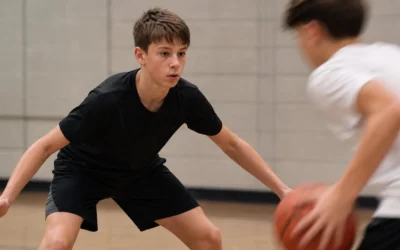
In practice this means creating competitive drills and game situations where failure is likely, where the stakes feel real, and where athletes must make decisions and execute skills under genuine pressure. Comebacks drills, make-or-miss pressure situations, competitive free throw shooting at the end of conditioning, and high-stakes small-sided games all create the conditions in which mental toughness is built.
The critical element is what happens after the adversity moment. A coach who responds to a player’s mental breakdown with criticism embeds the failure. A coach who acknowledges the difficulty, holds the player accountable to the standard, and then coaches them back to execution is doing actual basketball mental toughness training. The adversity is the stimulus. The coaching response is the development.
At You Hoop, adversity is built deliberately into every practice environment. We believe that toughness tested and handled correctly in the gym prepares athletes for every challenging moment outside of it.
3.2 Accountability Culture: Owning Mistakes Without Collapsing
One of the most important components of basketball mental toughness training is developing the habit of genuine accountability — taking ownership of mistakes, poor effort, or substandard execution without deflecting, making excuses, or going emotionally to pieces.
This is harder than it sounds for young athletes because the instinct when things go wrong is to protect the ego either by finding external blame or by beating oneself up so dramatically that the focus shifts from fixing the problem to managing the emotion.
Real accountability is calm, clear, and forward-focused. It sounds like: “That was on me. Here is what I am going to do differently.” It does not collapse into self-flagellation. It does not point fingers at teammates, coaches, or officials. It identifies the mistake, owns it, and moves to the next play.
Coaches build accountability culture by modeling it themselves — being willing to say “that drill did not work, here is what I am going to do differently” — and by responding to player mistakes with questions rather than judgments: “What did you see there? What would you do differently?” These questions teach players to analyze and own their performance rather than simply receive external evaluation of it.
3.3 Process Focus: Competing in the Present Moment
The athlete who is thinking about the last turnover while trying to execute the next play is not fully present for the next play. The athlete who is thinking about the score, the recruiter in the stands, or the consequence of a mistake is allocating mental resources to things that cannot be changed or controlled rather than to the only thing that can: the execution of the next action.
Basketball mental toughness training develops the ability to compete in the present moment by training process focus during practice — specifically by teaching athletes what to focus on during execution rather than just what not to focus on.
Process cues are specific, actionable instructions that direct attention to the execution of a skill rather than to outcomes: “See the target early.” “Strong hand finish.” “Communicate on defense.” These cues occupy the mental space that anxiety would otherwise fill.
Teaching players to use process cues consistently in practice builds the habit of present-moment focus that transfers to games automatically over time.
3.4 Competitive Drive: Building Intrinsic Motivation
Athletes who are motivated primarily by external validation — approval from parents, recognition from coaches, rankings and ratings — are fundamentally fragile. When the validation disappears or turns negative, the motivation goes with it. These are the athletes who perform brilliantly in practice when the coach is watching and disappear in games when the coach is evaluating. They are the ones who work hard in the summer when everyone is watching and coast through the winter when no one is keeping score.
Basketball mental toughness training builds intrinsic motivation — the drive that comes from within rather than from without. It is built by helping athletes connect to the reasons they play that have nothing to do with external outcomes: the love of competition, the satisfaction of improvement, the joy of executing something they have worked hard to learn, the feeling of being part of a team that is genuinely committed to each other.
When a player finds these intrinsic reasons and connects to them consistently, their work ethic and competitive intensity become self-sustaining. They do not need to be pushed because they are pulling. This is the foundation of sustained high performance at every level of the game.
3.5 Resilience: Bouncing Back From Setbacks and Failure
Every basketball player at every level experiences failure. Bad games, bad seasons, cuts from teams, losses in important moments, getting passed on the depth chart by a younger player, not getting the recruiting attention they expected. How a player responds to these setbacks is one of the most reliable predictors of how far they ultimately go in the game and in life.
Resilience is built through the experience of setbacks followed by recovery — not by avoiding setbacks or by being told that setbacks do not really matter. The player who sits on the bench for the first time and fights their way back into the starting lineup builds something that cannot be taught in a drill. The player who gets cut from a team and comes back better the following year builds something permanent.
The role of the coach and the parent in building resilience is to hold the standard while holding the belief. The standard means the setback is real and acknowledged. The belief means the player has what it takes to respond to it. Both are necessary. Minimizing the setback dismisses the real difficulty. Dwelling in it without belief embeds the failure.
Our core values at You Hoop include toughness specifically because we believe that the ability to build mental and emotional persistence through adversity is one of the most important things we can develop in every athlete in our program. Read more about who we are and what we believe on our About page.
3.6 Coachability: The Mental Habit That Accelerates Everything Else
The single most underrated component of basketball mental toughness training is coachability — the ability to receive feedback, instruction, and correction without defensiveness, without ego, and without delay in application.
A coachable player improves exponentially faster than an uncoachable one because every coaching interaction adds to their development rather than bouncing off their resistance. A player who genuinely listens to feedback, asks questions when they do not understand, applies corrections immediately in practice, and comes back the next session having worked on what was identified is getting more developmental value out of every minute on the court than a player with more talent who filters everything through their ego.
Coachability is a mental habit — and like all habits it is developed through consistent practice in the right environment. Programs that create psychological safety, that deliver feedback with clarity and care rather than with criticism and comparison, and that celebrate correction as a sign of growth rather than a mark of failure produce coachable athletes. Programs built on criticism, comparison, and shame produce athletes who protect their ego rather than develop their game.
3.7 Pressure Performance: Executing When It Matters Most
The final component of basketball mental toughness training is the ability to perform at your best when the moment is most important — to shoot the free throws at the end of the game with the same mechanics as the ones in open practice, to make the right read in the final possession, to compete at your ceiling when the pressure is highest rather than playing safe and hoping the moment passes.
Pressure performance is built through repeated exposure to high-stakes practice situations where the athlete learns that they can execute under pressure — not because someone told them they could but because they have done it. Each successful pressure performance in practice builds the belief that fuels the next one. Each practiced response to a failed pressure situation builds the resilience to keep competing when things go wrong in games.
Competitive drills, pressure free throws, timed challenges, and scrimmages with real stakes are all tools for building pressure performance in practice. The habit of competing at full intensity when something is on the line must be built in the gym before it can be relied on in games.
For more on how our program builds these mental habits through our competitive team and elite training environments, see our Skill Class page and book your session to get your athlete started.
4. The Role of Parents in Basketball Mental Toughness Training
Parents play a more significant role in a young athlete’s mental toughness development than most realize — for better and for worse. The behaviors, language, and responses that parents model and reinforce around their child’s athletic experience either build mental toughness or undermine it.
What builds mental toughness in young athletes:
- Celebrating effort and growth rather than outcomes and performance
- Allowing children to experience the natural consequences of mistakes without rushing to fix or explain them away
- Asking “what did you learn today” rather than “how many points did you score”
- Modeling composed, accountable responses to your own adversity and mistakes
- Trusting the coach to coach and staying in the stands rather than coaching from the sideline
What undermines mental toughness in young athletes:
- Criticizing coaching decisions or referee calls in front of or to the athlete
- Making the car ride home after a bad game a performance review
- Protecting children from difficult feedback by interceding between them and their coach
- Tying your emotional state to your child’s performance outcome — which teaches children that their performance has consequences for the people they love
- Communicating that anything less than elite performance is a disappointment
The parents whose athletes develop the strongest mental toughness are almost universally the ones who let the game be the teacher and show up as unconditional supporters rather than secondary coaches or performance evaluators.
5. Age-Appropriate Basketball Mental Toughness Training
Basketball mental toughness training should look different at different developmental stages. The principles are the same at every age. The application and the appropriate level of demand change significantly.
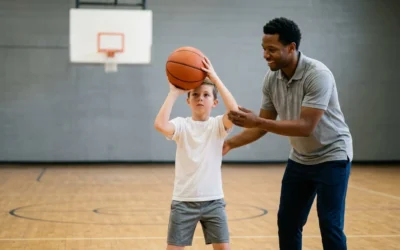
Foundation stage (3rd through 5th grade). The primary mental habit to build at this stage is coachability and genuine effort. Children at this age are building their relationship with competition, with failure, and with the experience of being coached. The most important thing a coach can do is create an environment where mistakes are safe — where trying hard and getting it wrong is celebrated as the path to improvement. Pressure performance training is not appropriate at this stage. Habit of effort and love of the process is.
Development stage (6th through 8th grade). Accountability, process focus, and resilience become development priorities at this stage. Players can now be coached to own their mistakes rather than deflect them. They can be taught and held to process cues during drills. They can experience meaningful setbacks — losing a close game, missing the last shot, getting moved to a lower tier — and be coached through the response. This is the stage when the mental habits that will define their high school experience are being established.
Performance stage (9th through 12th grade). All seven components of basketball mental toughness training become active development priorities at the high school level. Competitive drive, pressure performance, and resilience become most visible and most testable in this window. The athletes who have built these habits through the foundation and development stages arrive in high school prepared. Those who have not are trying to develop mental habits while simultaneously competing at the highest level of their career so far — a significantly harder task.

0 Comments
Trackbacks/Pingbacks